
Why it matters
The producer
Schuster works from Großriedenthal with a range that moves from wines labelled Wagram to Großriedenthal village wines and bottles from named Ried vineyards. Each step narrows the address on the label: Wagram names the regional setting, Großriedenthal points to the village, and a Ried names the vineyard site. Roter Veltliner sits at the centre of this structure, so a bottle such as Roter Veltliner Ried Altweingarten links grape, village and slope in one label.
The estate has remained a family business since 1772, but its current work is not fixed in one generation. Thomas Schuster’s internships in Germany, New Zealand and Austria, followed by a master’s degree at FH Eisenstadt, sit alongside the experience of Karl and Helga and the work he shares with Carina. That combination appears in a cellar approach built around gentle handling and time for wines to mature, while the family’s Roter Veltliner focus keeps the range rooted in Großriedenthal.
Place and vineyards
Where the wines begin
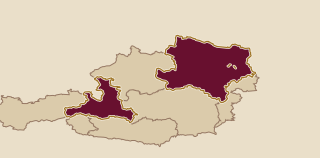
Wagram is the estate’s setting, and Großriedenthal is the village from which its wines take shape. The range includes Grüner Veltliner, Riesling, Sauvignon Blanc and Chardonnay alongside Roter Veltliner, plus Zweigelt and Pinot Noir in red. This broader planting allows the estate to show several grapes, while the repeated Roter Veltliner bottlings keep returning to the grape most closely associated with its work.
The estate’s vineyards are strongly marked by Wagram loess, a deep, fine-grained soil that is central to its white wines. Ried Altweingarten lies near Großriedenthal’s Kellergasse on a slight southeast incline, where loess surrounds the Roter Veltliner vines. The slope and site designation focus the bottle beyond a regional wine, while the 2025 Altweingarten’s juicy palate and long finish show why this vineyard receives its own name.
In the cellar
Vineyards and cellar
Organic cultivation is central to Schuster’s farming, and vineyard tasks are carried out by hand according to each vineyard, season and weather pattern. Working parcel by parcel means fruit can be handled in response to the year instead of by a single fixed routine. In the glass, that site-led approach is most explicit in the Ried wines, where Altweingarten, Eisenhut, Goldberg and Diebstein remain distinct names rather than disappearing into a regional blend.
The cellar is deliberately low in technology, with gentle treatment and maturation given time. For Roter Veltliner Ried Altweingarten 2025, hand-picked grapes received eight hours of skin contact before gentle pressing, stainless-steel fermentation and ageing on fine lees. The brief maceration and lees time bring texture and breadth to a dry white, while stainless steel keeps the wine’s almond and acacia-flower notes free of overt oak flavour.
Wines to know
The range in view
The Wagram wines form the broad base of the range: Grüner Veltliner, Roter Veltliner, Gemischter Satz, Sauvignon Blanc and Rosé vom Zweigelt. They sit beside Großriedenthal wines including Grüner Veltliner Alte Reben, Chardonnay and Zweigelt, then named-vineyard and reserve bottlings such as Roter Veltliner Ried Altweingarten, Roter Veltliner Ried Berg Eisenhut, Grüner Veltliner Ried Eisenhut and Riesling Ried Diebstein.
The upper part of the range also includes Roter Veltliner Ried Goldberg Edition Miriam, Grüner Veltliner Gutsreserve, Zweigelt Reserve and Pinot Noir Reserve. Sparkling, sweet and less conventional releases extend the picture further: Großriedenthal Brut Blanc de Blanc Große Reserve, Riesling Beerenauslese and Roter Veltliner Weitblick Natural. The result is not one house flavour repeated across every bottle, but a set of wines whose body, fruit, acidity and texture shift with grape, site and style.
A useful way in
A bottle to begin with
Start with Roter Veltliner Ried Altweingarten 2025. It is a dry, site-designated Roter Veltliner from a slight southeast-facing loess slope near Großriedenthal’s Kellergasse, made from hand-picked grapes with eight hours of maceration, gentle pressing, stainless-steel fermentation and time on fine lees. Almond and acacia flowers lead into a juicy palate with layered texture and a long finish. It brings the estate’s central grape, organic manual vineyard work and quiet cellar handling into one bottle.