
Why it matters
The producer
Weingut Frank is a family winery in Herrnbaumgarten, a village in the northeastern Weinviertel. Its winegrowing history reaches to 1724, while the present work is divided among several members of the Frank family. Harald Frank is responsible principally for vineyards and cellar work; Katrin Frank is co-owner and managing director, with training in viticulture, oenology and wine business. Daniela Frank looks after marketing and sales, and Johanna Frank works in the office while being described as knowing every vine in the estate’s sites. The result is a working estate with named responsibilities attached to the wines rather than an anonymous company structure.
The Frank family’s long local history begins with winegrowing in Herrnbaumgarten in 1724, and an importer describes ten generations at the estate. Continuity alone does not make a wine, however. The current structure joins family knowledge to defined jobs: Harald handles vineyard and cellar work, Katrin brings formal wine training to co-management, Daniela takes the bottles to market, and Johanna is closely connected to the individual vines.
Place and vineyards
Where the wines begin
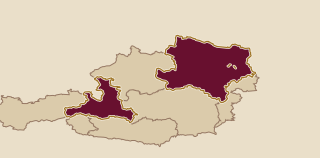
Herrnbaumgarten sits in the Weinviertel, the northeastern wine region of Lower Austria. Frank’s vineyards range from 180 to 320 metres, a spread that brings cooler nights during the season and can extend ripening into October. For grapes, cooler night air helps preserve fresh fruit character as maturity develops; for the finished wines, it offers a useful frame for the estate’s white Grüner Veltliner and Riesling alongside its red Zweigelt.
The regional name matters on the Grüner Veltliner Weinviertel DAC label, while Herrnbaumgarten appears directly on the Riesling. One bottle therefore speaks from the Weinviertel classification, and the other narrows the focus to the village where the family farms. The wines make the geography tangible without requiring a map at the table.
In the cellar
Vineyards and cellar
Frank’s vineyards can ripen into October in some seasons, because the higher sites bring cooler nights. Extra time on the vine can matter especially for aromatic white grapes and for red fruit: acidity and fruit flavour continue to develop alongside sugar, so harvest timing shapes weight, freshness and finish. Harald’s vineyard and cellar responsibility carries through both sides of that harvest decision.
Katrin Frank’s education in viticulture, oenology and wine business belongs to the same practical chain. Grapes are grown in a varied set of sites, then turned into wines whose labels distinguish a regional Grüner Veltliner, a village Riesling and a soil-named Zweigelt. The cellar work is therefore not presented as a detached technical exercise: it follows fruit coming from Herrnbaumgarten vineyards with different elevations and growing conditions.
Wines to know
The range in view
The supported bottles form a compact view of Frank’s range without claiming to list every wine. Grüner Veltliner Weinviertel DAC is the regional white: its DAC name ties Grüner Veltliner to the Weinviertel on the label. Riesling Herrnbaumgarten moves from region to village, putting the family’s home place beside a grape associated with fragrant fruit and lively acidity. Together, they provide two white-wine routes into the estate: one through the regional designation and one through Herrnbaumgarten.
Zweigelt Kalk und Löss supplies the red counterweight. A January 2026 review of the 2023 described a soft wine with berry fruit and a notably sweet-fruited finish. The wine’s structure is therefore less about hard tannin than a gentle palate and ripe-fruit impression, while the Kalk und Löss name keeps the bottle linked to the ground it references. These three wines divide the range by grape, colour and label scale: regional Grüner, village Riesling and soil-named Zweigelt.
A useful way in
A bottle to begin with
Start with Zweigelt Kalk und Löss, in the 2023 vintage. It is the Frank bottle with the most concrete picture in the glass: berry fruit, a soft palate and a sweet-fruited finish. It also gathers several parts of the estate into one label: Zweigelt as the red grape, Kalk und Löss as the site clue, and Herrnbaumgarten as the family’s home village. The wine does not try to explain the whole range; it offers the most direct first encounter with Frank’s red-wine side.