
Why it matters
The producer
Netzl’s central fact is the handover happening in public: Christina manages the business while continuing to exchange experience with her parents. That puts her wines beside Franz’s established estate range, rather than replacing it, and makes bottles marked Christina a useful parallel view of the same Carnuntum surroundings.
The estate traces its grape-growing history to 1820. It currently identifies Lacon GmbH AT-BIO-402 as its organic certification, tying the family story to a stated vineyard practice rather than to a decorative claim on the label.
Place and vineyards
Where the wines begin
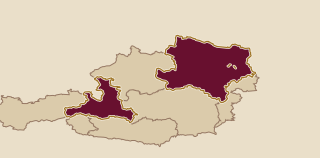
The vineyards surround Göttlesbrunn in Carnuntum, in Austria’s far east. Carnuntum is the regional setting that connects the bottles; within it, named places such as Haidacker and Bärnreiser separate the conditions in which the red grapes grow.
Prellenkirchen Blaufränkisch occupies another clear position in the range: it is a named appellation-level wine rather than a general red blend. The label therefore directs attention to Blaufränkisch and its stated origin, while the Anna-Christina Bärnreiser brings three varieties and new oak into the frame.
In the cellar
Vineyards and cellar
The estate puts organic vineyard management first across its currently stated 28 hectares. That choice concerns the fruit before it reaches the cellar, where individual wines then take different routes rather than following one uniform treatment.
The clearest documented cellar example is Anna-Christina Bärnreiser, a blend of Zweigelt, Merlot and Cabernet Sauvignon matured for 18 months in new barriques. New oak is therefore part of this wine’s construction, adding a fuller frame around the blend’s fruit and tannin. Christina Zweigelt 2023 and Prellenkirchen Blaufränkisch also have documented élevage, but their supplied record does not support folding their methods into the Anna-Christina recipe.
Wines to know
The range in view
The range is built around several red-wine roles. Haidacker puts Zweigelt in a loess-rich site with forest-cooled nights; its likely role is a dry red in which fruit and acidity can sit together without the weight of a three-grape, new-barrique blend.
Prellenkirchen Blaufränkisch places a single named red variety at appellation level. Blaufränkisch brings tannin and acidity into the range architecture, making it a different proposition from a varietal Zweigelt even before any cellar details are considered.
A useful way in
A bottle to begin with
Start with Anna-Christina Bärnreiser. It is a cuvée of Zweigelt, Merlot and Cabernet Sauvignon, matured for 18 months in new barriques, so grape blend and cellar work are both plainly present in the glass. Expect a dry, full-bodied red with fruit, oak, firm tannin and a sustained finish. It is the most direct bottle for seeing how Netzl moves beyond a single grape or site into a deliberately built Carnuntum red.