
Why it matters
The producer
Fred Loimer’s early work with Grüner Veltliner included barrique experiments in the early 1990s. Putting a grape often presented in a direct, fresh register into small oak barrels tested how texture, weight and oak could alter its shape. After taking over in 1998, Loimer built a winery whose bottles extend beyond one grape or one style: the estate now joins vineyard sources in two Lower Austrian areas with still, skin-contact and sparkling wines.
The estate’s recent arc is marked by decisions with visible wine consequences. Loimer took over from his father in 1998 after already testing barrique-aged Grüner Veltliner, then broadened the vineyard base through the Gumpoldskirchen lease in 2004. In 2006 the winery began converting to biodynamic agriculture, and Fred Loimer co-founded respekt-BIODYN the following year. The farming change sits alongside a cellar programme that can be conventional in one bottle and deliberately hands-off in another: the Achtung wines use natural yeast, extended skin contact and maturation without additives.
Place and vineyards
Where the wines begin
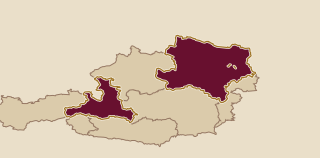
Langenlois is the estate’s home, at Haindorfer Vögerlweg 23, while its grape supply reaches across two distinct wine areas. Kamptal remains one part of the estate’s foundation; the 2004 lease of Weingut Schellmann added vineyards around Gumpoldskirchen in the Thermenregion. That arrangement matters on the label and in the cellar: Loimer is not confined to a single local vineyard story, and its range can move between regional still wines, sparkling cuvées and the separate Achtung bottlings.
The most tangible site beneath the winery is not a named vineyard but a 150-year-old, hand-dug loess cellar in Langenlois. Loess is the pale, fine sediment into which the cellar was cut; its hand-dug construction makes the underground space part of the estate’s physical fabric rather than a recent technical addition. Above it stands the winery built in 2000, linking the place where wine matures below ground with a sharply contemporary working building above.
In the cellar
Vineyards and cellar
Biodynamic conversion began in 2006, placing vineyard work at the centre of the estate’s direction before grapes reach the cellar. In the Achtung range, fermentation starts spontaneously with natural yeast rather than an added cultured strain. The wines then remain on their skins for weeks or months and mature without intervention or additives. Skin contact keeps juice in contact with grape solids, bringing more texture and phenolic grip to the palate; the extended contact makes these bottles a different proposition from a straightforward fresh white.
The cellar also has a long-running sparkling thread. Loimer made a 100% Pinot Noir Blanc de Noirs in 1991 and intensified the sparkling focus from 2011. One documented Extra Brut Reserve release spent two and a half years on lees before disgorgement in April 2022. Lees ageing keeps a sparkling wine in contact with spent yeast, building the material behind its mousse and adding depth to its finish.
Wines to know
The range in view
The range is best approached as three distinct expressions of the estate’s work. Grüner Veltliner carries the history of Loimer’s early barrel trials, where oak, body and texture entered the conversation around the grape. The Achtung wines take the opposite route in the cellar: natural yeast, weeks or months on skins, and no additives create wines in which fermentation character, dry texture and grip are central.
Sparkling wine forms its own branch, not an afterthought. The early Pinot Noir Blanc de Noirs established a precedent, while Extra Brut Reserve brings extended lees ageing into the current range. Its name signals a dry sparkling style, and its documented assessments focus on mousse, fruit, texture, structure and finish rather than simple fruitiness. These are wines made to show how base wine, time on lees and a low-dosage style can carry weight without turning sweet.
A useful way in
A bottle to begin with
Choose the Extra Brut Reserve first. It gathers several durable threads in Loimer’s work: a sparkling programme with roots in the 1991 Pinot Noir Blanc de Noirs, a stronger estate focus from 2011, and documented extended lees ageing. Expect dry mousse, fruit held within a structured palate, and a finish shaped by time on lees rather than by sweetness. It is the most direct way to meet the estate’s interest in texture, fermentation and time without beginning with the more skin-driven Achtung wines.