
Why it matters
The producer
Hannes Sabathi made his first wine at 16. Today, the estate’s defining image remains physical rather than ceremonial: Sabathi digs holes among the vines to inspect the ground. That attention matters most on labels carrying a vineyard name, where Sauvignon Blanc is asked to show the difference between Kranachberg’s gravelly basin and the heavier Opok of Loren.
Karin Sabathi describes the wider team as the support that gives Hannes room to move and work. The consequence is a producer whose bottles are organised around sites and seasons, with the vineyard name carrying practical information about where the grapes grew.
Place and vineyards
Where the wines begin
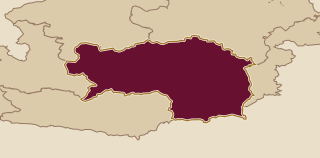
Steiermark sits in southeastern Austria, and Sabathi’s vineyards work between cool Alpine air and a continental climate. Temperature differences of up to 20°C between day and night slow the move from daytime ripeness into night-time conditions; in the estate’s Sauvignon Blanc, that setting suits fruit with lift rather than blunt weight.
The labels use the Styrian origin ladder: Gebietswein for regional wine, Ortswein for village wine, and Riedenwein for a named single vineyard. A Riedenwein such as Sauvignon Blanc Ried Kranachberg Kreuz narrows the address from Steiermark to one particular growing place, then leaves the vintage to do its part.
In the cellar
Vineyards and cellar
Sabathi’s vineyard practice starts with observation: holes dug among vines reveal the ground directly, while the climate brings cool air against continental warmth. These are not interchangeable details. Soil and temperature both vary by site and season, so a vineyard name on a white-wine label has a job beyond decoration.
In the cellar, the estate holds its single-vineyard wines back: they are bottled no earlier than one year after harvest. That time allows the wine to take shape before release, and it suits a range built around vineyard and vintage rather than immediate, uniform fruitiness.
Wines to know
The range in view
The planting is predominantly Sauvignon Blanc, Muskateller, Weissburgunder, Grauburgunder, Chardonnay and Welschriesling. Those grapes appear through the Styrian progression from regional to village and single-vineyard wines, so the range moves from a broad regional statement toward bottles tied to a smaller address.
Sauvignon Blanc is the clearest thread. At the Kranachberg level, the 2021 Kreuz bottling is described as salty and mineral, with ripe exotic fruit; its compact shape connects the grape to a named parcel rather than treating Sauvignon Blanc as a single fixed taste. Chardonnay, the Pinot varieties and Welschriesling widen the range, while the site hierarchy keeps the label legible.
A useful way in
A bottle to begin with
Start with the 2021 Sauvignon Blanc Ried Kranachberg Kreuz G STK. It is a single-vineyard Sauvignon Blanc from the family’s 500-metre Kranachberg basin, where calcareous soil and sandy gravel provide the physical setting behind the wine’s salty, mineral shape. The aromas are specific—gooseberry, mandarin, flowers and herbs—while the compact palate keeps the fruit dry and savoury.