
Why it matters
The producer
Weingut Hiedler is a family estate in Langenlois, in Austria’s Kamptal, founded in 1856 by Josef and Anna Hiedler. Its first vines were in Thal and Spiegel; today the family farms 30 hectares and works mainly with Grüner Veltliner and Riesling, alongside Weissburgunder. Ludwig and Dietmar Hiedler took responsibility in 2023, with Ludwig named as winemaker in independent producer records. The estate’s bottles move from regional wines to named-vineyard releases, so the grape remains familiar while the vineyard name signals a more particular slope and soil.
The Hiedlers began with Thal and Spiegel in 1856, then expanded a family vineyard holding into a modern Kamptal estate without abandoning named sites. In 1992, Ludwig Hiedler and like-minded growers helped establish the Traditional Austrian Wine Estates association, which focused attention on important Danube vineyard sites. That work sits naturally beside Hiedler’s own range, where a label such as Steinhaus or Gaisberg directs attention to the origin of the grapes rather than only to a grape variety.
Place and vineyards
Where the wines begin
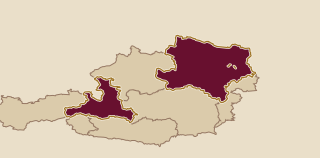
Kamptal brings together warm daytime air from the Danube plain and cooler air from the northwestern highlands. That day-and-night swing slows ripening, helping Grüner Veltliner retain acidity beside its spice and allowing Riesling to keep citrus definition as its fruit develops. In Langenlois, Hiedler’s named sites turn that climate into distinct labels: Steinhaus for Riesling, and Thal, Kittmannsberg, Schenkenbichl and Käferberg for Grüner Veltliner.
Steinhaus is Hiedler’s steepest site in Langenlois. Its terraces carry thin humus over gneiss, amphibolite, quartz and feldspar, and vine roots work into fissures in the rock. Riesling from this ground is documented with lime, citrus peel, cool mineral notes and a firm grip, a shape that fits a lean topsoil and rocky slope rather than broad, soft fruit.
In the cellar
Vineyards and cellar
Hiedler describes its vineyard work as organic and guided by regenerative-agriculture principles. Herbicides, insecticides and artificial fertilisers were removed decades ago; cover crops, compost and limited soil disturbance are used in the rows. Hand work matters on steep and varied sites because fruit can be picked selectively rather than treated as one uniform crop, helping acidity and ripeness arrive together in the press.
In the cellar, the estate uses natural yeast, gentle pressing and extended lees ageing. Fermentation and ageing can take place in steel, acacia or small oak vessels, while malolactic fermentation is neither blocked nor forced. The result is not one fixed recipe: steel can keep citrus and floral fruit direct, lees can add texture, and a completed malolactic fermentation can soften the edges of acidity when the wine calls for it.
Wines to know
The range in view
The range is organised through grape and vineyard. Grüner Veltliner appears from Thal, Kittmannsberg, Schenkenbichl and Käferberg, where spice, fruit weight and smoky, savoury notes can follow the site’s metamorphic ground. Riesling comes from Steinhaus, Gaisberg and Heiligenstein, with the grape carrying citrus, white peach and mineral detail more readily than oak sweetness.
Weissburgunder has a particular place at Hiedler through Schenkenbichl. Its lower-yielding fruit offers a different texture from Grüner Veltliner: less peppery, often broader through the middle, and useful alongside Kamptal’s high-acid white wines. Named-vineyard releases make the range less about a simple ladder of quality than about choosing grape and ground together.
A useful way in
A bottle to begin with
Riesling Ried Steinhaus 2024 is the first bottle to try. It is a dry 1ÖTW Erste Lage Riesling from Steinhaus, Hiedler’s steep, thin-soiled Langenlois site. The grapes were selectively hand-harvested over several passes, destemmed, lightly crushed, macerated for several hours, gently pressed, fermented in steel and aged on lees for several months.