
Why it matters
The producer
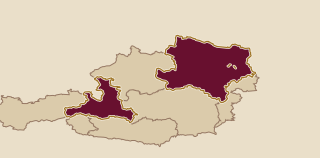
Weingut Hirsch is Johannes Hirsch’s Kammern estate in Austria’s Kamptal. The family works from a 500-year-old tithing farmstead and concentrates on Grüner Veltliner and Riesling; those two grapes shape both the everyday bottles and the vineyard-labelled wines. Grüner Veltliner accounts for the larger share of plantings, while Riesling supplies the Zöbing and single-site bottlings, so the label usually tells you whether the glass will turn towards peppery, textured Grüner or citrus-led Riesling.
The Hirsch family has been at the farmstead since 1878, when winegrowing sat alongside other crops. During the 1970s, Johannes Hirsch’s father Josef began putting more of the family’s work into wine, shifting the estate’s centre of gravity towards vineyard bottles. Organic farming also began in that decade. Johannes later became a founding member of Respekt in 2006, while the farm’s focus remained practical: Grüner Veltliner and Riesling from the slopes around Kammern and Zöbing.
Place and vineyards
Where the wines begin
Kammern and nearby Zöbing sit within Kamptal, where Hirsch reports that 85% of its holdings are on slopes in those two places. That distribution matters because the range is organised around named vineyards rather than a single blended estate wine: a Kammern site can appear as Ried Lamm Grüner Veltliner, while Zöbing appears on Riesling labels such as Ried Heiligenstein. Place is therefore not background on these bottles; it is part of the wine’s name and its intended shape.
The documented site picture is one of slopes, not a single uniform vineyard floor. Hirsch works named sites including Lamm, Gaisberg, Grub, Renner and Heiligenstein-Rotfels, then bottles several of them separately. A vineyard name on a Hirsch label signals a narrower origin than a village wine, and the estate supports that distinction in the cellar with a different maturation approach for its Erste Lage wines.
In the cellar
Vineyards and cellar
Hirsch describes its vineyards as biodynamically cultivated. In the cellar, grapes are whole-cluster pressed and fermented with ambient yeasts, without temperature control; malolactic fermentation is blocked. The result is a production sequence designed to retain the grapes’ acidity rather than soften it through malolactic conversion, while extended lees ageing adds body and a more settled texture before bottling.
The cellar changes as the range rises. Basic and village wines are generally fermented and matured in stainless steel, keeping fruit, acidity and grape character in view. Erste Lage wines combine steel and oak, with more steel used in warmer years. Oak is therefore not a fixed house flavour: its role shifts with the vintage, while lees time supplies texture and length across the range.
Wines to know
The range in view
Hirschvergnügen and the village-level wines introduce the estate through stainless-steel handling, where Grüner Veltliner can show dry fruit, acidity and a firmer peppery grip, and Riesling can carry citrus and floral notes on a lighter body. Zöbing Riesling and Hirschin Riesling sit in that part of the range, before the labels narrow to individual vineyards.
At the site level, Ried Gaisberg appears in both Grüner Veltliner and Riesling, while Ried Lamm is Grüner Veltliner and Ried Heiligenstein and Heiligenstein-Rotfels are Riesling. Ried Heiligenstein Riesling 2017 is a Zöbing single-site Kamptal DAC and 1 ÖTW wine; Ried Gaisberg Riesling 2015 is Kamptal DAC Reserve and 1 ÖTW. Ried Lamm Grüner Veltliner 2022 is a Kammern single-site Kamptal DAC and 1 ÖTW wine. These bottles receive the steel-and-oak approach, so their fruit is carried by more weight and lees-derived texture than the stainless-steel wines.
A useful way in
A bottle to begin with
Begin with Ried Lamm Grüner Veltliner 2022. It is a single-site Kammern Grüner Veltliner classified as Kamptal DAC and 1 ÖTW, joining Hirsch’s principal grape to one of its named vineyards. The wine’s dry fruit, spice, acidity and savoury grip show Grüner Veltliner in a fuller frame, while the steel-and-oak maturation and lees ageing bring weight and texture without obscuring the fruit. It is the bottle to choose when a crisp village Grüner feels too slight but a richly oaked white feels too heavy.