
Why it matters
The producer
The estate is based at Kettergasse 24 in Piesport, in a house dating from the 16th century. Its name joins two families: Carl Hoffmann, a Piesport agricultural-machinery dealer, and Maria Simon, a winegrower from Maring. That family connection reaches into the vineyard map today, because the estate’s six sites lie across Piesport, Maring, Klüsserath and Köwerich rather than around one village alone.
Dieter Hoffmann joined the family operation fully in 1994, taking responsibility for vineyard and cellar work after studying viticulture and oenology at Geisenheim; he passed his diploma examination in 1993 and became owner in 1999. His training sits behind a Riesling-led estate where site names, grape and cellar handling are meant to remain legible in the bottle.
Place and vineyards
Where the wines begin
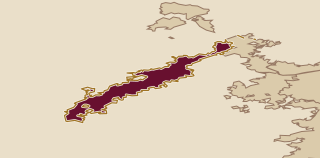
Piesport is the estate’s home, but Hoffmann-Simon’s vines extend along several Mosel communities. This matters because a village or vineyard name is more than decoration on a Riesling label: it identifies where the fruit was grown, while the grape provides the shared thread of high natural acidity and citrus-led freshness across the range.
Klüsserather Bruderschaft is a Mosel vineyard in Klüsserath, and Hoffmann-Simon is among its producers. A bottle carrying that name is therefore a vineyard-addressed Riesling, not simply a generic Mosel wine; its narrower origin helps explain why it is treated separately from Blauschiefer in the estate’s range.
In the cellar
Vineyards and cellar
Organic conversion began in 2012 and reached certified status with the 2015 vintage. For a Riesling estate on steep holdings, that choice places vineyard condition at the centre of the work: healthy fruit must arrive with sufficient ripeness and acidity because those are the elements that determine citrus character, body and finish in the glass.
The cellar reports no fining and natural alcohol. Those choices do not prescribe one flavour for every cuvée, but they establish a consistent approach: the wine’s fruit, acidity and extract are allowed to carry the palate, while individual vineyard wines can show different weight, spice and development over time.
Wines to know
The range in view
Riesling is the backbone of the range, with 6.5 of the estate’s 10 hectares planted to it. Müller-Thurgau is the smaller companion grape, covering 1.5 hectares, while the named Rieslings provide the clearest view of how Hoffmann-Simon separates bottle roles. Klüsserather Bruderschaft is the vineyard-specific wine; Blauschiefer is another named Riesling with its own structural profile.
The available assessments describe Bruderschaft with fruit and creamy texture held in a taut shape, while Blauschiefer is noted for structure, spice and capacity to develop. That makes the contrast practical: Bruderschaft brings a more detailed vineyard name and a creamier fruit register; Blauschiefer brings spice, grip and a firmer frame. Both need food or time in the glass more than sweetness to create interest.
A useful way in
A bottle to begin with
Start with the 2024 Klüsserather Bruderschaft Riesling. It is confirmed as 100% Riesling and carries a specific Klüsserath vineyard on the label, bringing the estate’s four-village footprint into focus through one defined address. Expect fruit first, then a creamy feel through the middle, with acidity tightening the palate and extending the dry finish. That combination of fruit weight, texture and acidity makes it a useful first bottle because it shows both Mosel Riesling’s lift and Hoffmann-Simon’s site-led range.