
Why it matters
The producer
Georg Julius runs Weingut Julius from Gundheim with Christine Julius associated with the estate. The family history begins with a farm acquired by Georg Julius’s grandfather; the estate dates that purchase to 1928. Georg Julius developed the property into a wine estate with 21 hectares of organically farmed vines, turning a broader farm into a business whose most firmly documented wine language is dry, site-named Riesling.
The Julius family’s route into wine began with a farm, not a purpose-built winery. Georg Julius’s grandfather acquired the property, and a later generation developed it into a vineyard estate. The change is tangible in today’s 21 hectares of organically farmed vines: the farm’s agricultural base became a collection of vineyards whose work is focused on fruit for estate wine, including Riesling labelled with Bermersheimer Hasenlauf.
Place and vineyards
Where the wines begin
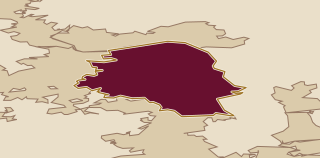
Gundheim sits in southern Rheinhessen, the German region on the label that places Julius within one of the country’s major wine areas. Here, Riesling from Bermersheimer Hasenlauf carries a more specific place name: Bermersheimer Hasenlauf identifies the vineyard or site attached to the wine, while trocken tells you that the finished Riesling is dry. Those two words narrow the bottle from regional origin to a particular site and style.
The vineyards are rooted in loess-clay soils and work within a mild southern-Rheinhessen microclimate. Loess and clay can hold water through drier periods, while the moderate setting supports ripening; in the Hasenlauf Riesling, the result is described through ripe apple and peach alongside a nutty, mineral edge rather than through sweetness. The named site is therefore useful on the label: it directs attention to a particular Riesling expression, not a generic regional blend.
In the cellar
Vineyards and cellar
The estate converted to cultivation under Naturland organic-winegrowing rules in autumn 2007. Cover crops grow between the vine rows, providing habitat for plant and animal life, and most vineyard work is done by hand. Those choices keep work close to each row and each vine; for a dry Riesling, they place the emphasis on clean fruit and site character before the wine reaches the bottle.
The documented 2023 Hasenlauf Riesling Trocken is also listed as vegan. That is a practical detail for the bottle rather than a flavour claim: its dry Riesling profile remains defined by fruit, acidity and the Bermersheimer Hasenlauf name on the label.
Wines to know
The range in view
Riesling is the central confirmed grape, with Bermersheimer Hasenlauf supplying the key named-site bottling. The 2023 Weingut Julius Hasenlauf Riesling Trocken is listed as a single-variety wine, so the variety is not hidden behind a blend: Riesling supplies the wine’s citrus-and-stone-fruit frame, while the dry finish keeps the palate firm and food-friendly.
Within that documented range, the useful distinction is between the grape and the site. “Riesling” describes the variety; “Bermersheimer Hasenlauf” identifies where this example comes from; “Trocken” signals dry wine. Apple and peach fruit soften the line of acidity, while nutty and mineral notes add savoury detail and length.
A useful way in
A bottle to begin with
Start with the 2023 Weingut Julius Hasenlauf Riesling Trocken. It is a single-variety, vegan-listed dry Riesling from the Bermersheimer Hasenlauf site, and it brings the producer’s most clearly documented elements into one bottle: Gundheim, organic vineyard work, a named site and the bright shape of Riesling. Expect apple and peach fruit, a mineral and lightly nutty note, moderate body and a dry, acidity-led finish. It comes first because the label itself teaches how Julius connects grape, site and style.