
Why it matters
The producer
Landmann presents itself as a traditional Baden wine estate, but its current chapter has a clear date: Jürgen Landmann took over in 1995, initially alongside his brother, before taking sole responsibility in 2013. The long family ownership provides continuity; the named Pinot Noir provides a practical view of the present cellar. Alpensegler is not presented as an abstract house style, but as a wine whose harvest and fermentation details can be followed into the glass.
The estate’s history reaches back at least to 1667 in the family account. Josef Landmann took over in the 1950s, and his wife became Baden’s first wine princess, placing one branch of the family story in the public life of the region. Jürgen Landmann’s later stewardship carries that estate into its current organic programme. The result is a Baden producer whose documented range runs from a named, hand-harvested Pinot Noir to the longer-matured L.L.L. wines.
Place and vineyards
Where the wines begin
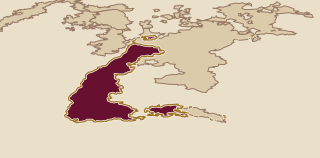
The estate address is Umkircherstraße 29 in Freiburg-Waltershofen, in Baden, Germany. Baden is the regional setting named for Landmann’s wines; the material retained here does not attach Alpensegler to a particular village appellation or vineyard parcel. That matters on the label: the bottle is best understood first through its producer, Baden setting and Pinot Noir grape, rather than through an unsupported site name.
Landmann names top sites and low yields among its working criteria, while the retained material does not name individual soils or parcels. The physical site story therefore begins with crop level rather than a speculative geological claim. Fewer grapes can mean more attention is concentrated in the fruit that remains, and Alpensegler’s medium body and persistent finish fit a Pinot Noir handled for shape rather than sheer weight.
In the cellar
Vineyards and cellar
Organic cultivation sits at the centre of Landmann’s stated approach, and products comply with Bioland guidelines unless otherwise identified. Low yields and selected sites are paired with an intention to make wines without unnecessary alteration. For Alpensegler Pinot Noir Organic 2022, the vineyard work continues through hand harvesting, so fruit is picked by hand rather than machine.
In the cellar, Alpensegler is spontaneously vinified and then matured before release. Spontaneous fermentation lets the process begin without a specified commercial yeast, while maturation gives the finished wine time to settle into its fruit, acidity and tannin. Elsewhere in the range, the premium L. L. L. wines receive extended ageing in French oak. That creates a separate cellar lane: Alpensegler is the documented Pinot Noir, while L. L. L.
Wines to know
The range in view
The documented Landmann range has two useful points of reference. Alpensegler Pinot Noir Organic 2022 is a named organic red made from Pinot Noir, picked by hand and spontaneously vinified. Its medium body, fresh acidity and mature tannin describe a red built around lift and grip rather than heavy extraction. Red-fruit character keeps Pinot Noir at the centre of the bottle.
The L.L.L. wines occupy the premium end of the documented range and receive extended maturation in French oak. French oak ageing can add wood-derived spice and broaden texture, but the available information does not assign a grape, vintage or individual cuvée to that line. Together, the two references show an estate working with both a clearly described Pinot Noir and a longer-aged French-oak selection.
A useful way in
A bottle to begin with
Start with Alpensegler Pinot Noir Organic 2022. It is the Landmann bottle for which grape, farming and cellar work are all documented: organic production, hand harvesting, spontaneous vinification and maturation before release. Expect floral and red-fruit aromas, herbs and spice, then medium body, fresh acidity, mature tannin and a lasting finish. It puts Baden Pinot Noir and Landmann’s stated preference for unadulterated wine in the same glass.