
Why it matters
The producer
The address is Ludwig-Schwamb-Straße 22 in Osthofen, in the Wonnegau area of Rheinhessen. Peter and Fritz May make the important vineyard and cellar decisions together, so the same family oversees fruit from several villages and the wines that carry those places onto the label. That shared work matters most in the Rieslings, where a broad estate bottling and a named-site wine can show different degrees of fruit weight, saltiness and ageing capacity.
The May family has been connected with wine since 1815, and the estate now works under two brothers rather than a single proprietor. Peter and Fritz May inherited a long local history, then made a modern farming decision when the vineyards converted to organic cultivation in 2007. Organic work changes the daily vineyard routine before the grapes reach the cellar; at Karl May it sits alongside a Riesling range where dry fruit and acidity need to arrive intact enough for site differences to remain legible.
Place and vineyards
Where the wines begin
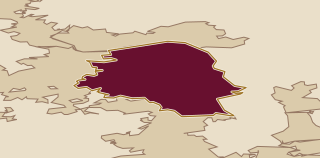
Osthofen is the estate’s base, but its vines extend west and south through Bechtheim and Westhofen. This spread gives the brothers more than one origin to work with: a Riesling labelled simply as Classic can gather an estate-wide picture, while Goldberg, Geyersberg and Morstein draw attention to particular ground. The names are useful because they signal a move from an everyday dry Riesling towards wines whose acidity, texture and mineral character are tied more closely to a single site.
Limestone is the recurring material beneath Karl May’s Riesling. In Osthofen Goldberg, the producer describes wines as mineral, nearly salty and structured by acidity, with the ability to age. Salt on the finish is not a flavouring; it is the savoury, mouthwatering effect that can make dry Riesling feel longer and firmer after the citrus fruit has passed.
In the cellar
Vineyards and cellar
The estate’s ecological vineyard work is joined by spontaneous fermentation, maturation in different vessels and time on fine lees. Spontaneous fermentation lets the must ferment without a selected commercial yeast addition, while fine lees are the spent yeast cells left after fermentation. Together, those choices can broaden the palate and add a gentle creamy texture without turning dry Riesling into an oaky wine.
For a limestone-led range, the practical aim is clear in the finished shape of the wines: fruit remains present, acidity provides lift, and lees can give the middle of the palate more weight. The cellar methods do not erase the contrast between a broad estate bottling and Goldberg’s nearly salty profile; they support a dry finish in which citrus, stone and savoury notes can remain distinct.
Wines to know
The range in view
Karl May’s documented range is Riesling-led. Riesling Classic is the wide-angle dry wine: the 2020 bottling was organic and listed with 0.5 grams of sugar per 100 millilitres, a figure that places sweetness well behind fruit and acidity. Riesling Trocken is a more structural step, with published tasting notes for the 2020 describing youthful light fruit, a full dry palate and fine acidity.
Riesling Kabinett introduces another register in the line-up, while Geyersberg, Goldberg and Morstein connect Riesling to named sites. Goldberg is the clearest indication of what the estate seeks from a limestone parcel: mineral character, salt-like savour, firm acidity and the structure to develop with age. Pinot Blanc, Pinot Gris and Pinot Noir broaden the cellar beyond Riesling, but the Riesling bottles provide the most direct route through the estate’s ground and methods.
A useful way in
A bottle to begin with
Start with the 2020 Riesling Classic. It is an organic Riesling with 0.5 grams of sugar per 100 millilitres, so its role is to show the estate’s dry house style without requiring a site comparison first. Expect fresh fruit, a dry palate and acidity rather than overt sweetness; the fine-lees approach should give the wine some texture through the middle before a clean finish. It comes first because it establishes the basic Karl May combination of Riesling fruit, dryness and acidity before the named limestone wines add more mineral savour and grip.