
Why it matters
The producer
Weingut Katharina Wechsler works from Westhofen’s historic centre, where the family business reaches back to the eighteenth century. Katharina Wechsler formally took charge in 2017 and put her name on an estate that had long supplied bulk wine. Its bottles now centre on dry Riesling from Westhofen, with vineyard names such as Kirchspiel, Morstein and Benn carrying the distinction between village fruit and individual sites onto the label.
Katharina Wechsler did not come straight into the cellar. Born in Worms in 1979 and raised on the family’s Westhofen bulk-wine estate, she studied French Literature in Paris, then Social and Political Sciences in Stuttgart, before working as a junior television editor in Berlin from 2006. In 2009 she entered winemaking school in Oppenheim. By 2012, when she graduated, the family had begun bottling its own wine rather than sending it anonymously into the bulk market.
Place and vineyards
Where the wines begin
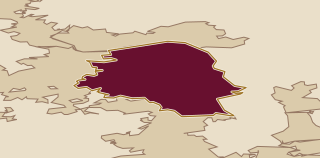
Westhofen is one of Rheinhessen’s important addresses for dry Riesling, and Wechsler’s holdings sit among its limestone-rich vineyards. Kirchspiel and Morstein are recognised grand cru sites, while Benn is the family’s entirely owned vineyard between them. A Kirchspiel or Morstein label therefore narrows the wine to a named slope; Benn names a privately held site with a different mix of soils and grapes across its length.
Benn changes character from top to bottom. Its upper section has limestone and is particularly relevant to Riesling, while the lower, warmer ground moves into deeper loess and a broader patchwork of varieties. Limestone is associated here with dry whites that retain acidity and a chalky, salty texture; the deeper lower soils suit riper fruit and give the estate room for Pinot varieties, Silvaner, Scheurebe and less conventional wines alongside Riesling.
In the cellar
Vineyards and cellar
Organic conversion began in 2018, with 2021 described as the first officially certified vintage; biodynamic practices followed from 2020. Compost and herb-rich vineyard floors are used in the vineyards, keeping the farming focus on living soils rather than a bare, worked surface. For the central dry Rieslings, fermentation and ageing in stainless steel preserve citrus fruit, acidity and the saline edge of the sites without adding oak flavour.
Cellar work changes with the grape. Spätburgunder Westhofener Kalk 2022 comes from limestone parcels in Westhofen, then goes through whole-cluster fermentation and barrel ageing. The stems and wood bring savoury spice, tannin and a broader texture to Pinot Noir, rather than the lean, steel-raised profile used for the dry Rieslings.
Wines to know
The range in view
The core range moves from dry estate and village Riesling to named-site bottlings from Kirchspiel, Morstein and Benn. Those Rieslings keep the focus on ripe citrus and orchard fruit, high acidity and dry finishes, while the vineyard names bring more site detail to the texture and mineral character. Kirchspiel and Morstein sit at the classified end of the range; Benn stands apart as the family’s own site rather than a grand cru designation.
Beyond Riesling, Wechsler works with Silvaner, Scheurebe, Grauburgunder, Chardonnay, Weissburgunder and Spätburgunder. The Cloudy by Nature wines, orange wines and Fräulein Hu sparkling wines use this broader material for different textures: skin-contact or natural wines can bring more grip and earth, while sparkling rosé brings mousse, fresh fruit and a drier, brisker shape. Spätburgunder Kalk occupies another lane again: a red Westhofen wine with whole-cluster savour and barrel-grown weight.
A useful way in
A bottle to begin with
Choose Spätburgunder Westhofener Kalk Ortswein 2022 to see Westhofen from the red side. It is Pinot Noir from limestone parcels, made with whole clusters and aged in barrel, so the glass joins red fruit with savoury spice, tannin and a fuller texture than the estate’s steel-raised Rieslings. It also makes the estate’s range easier to read: the same Westhofen ground supports dry, mineral white wine and a structured, earthy red.