
Why it matters
The producer
Katharina Wechsler grew up in Westhofen on her family’s bulk-wine estate, then left for studies in Paris and Stuttgart before becoming a junior television editor in Berlin in 2006. Her return in 2009 led to winemaking school in nearby Oppenheim; her 2017 takeover put her name on the label and redirected the business towards bottles shaped by grape and vineyard work.
Manuel Maier joined the management team in April 2022. The estate’s current character comes from that family property being used for a wider set of wines: dry Riesling provides the white-wine backbone, while Burgundian grapes and more experimental skin-contact wines broaden what Westhofen can look like in bottle.
Place and vineyards
Where the wines begin
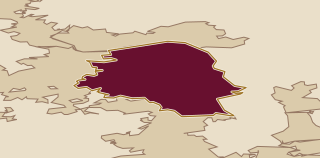
Westhofen sits in Rheinhessen, and it is the fixed address behind wines that may otherwise seem stylistically far apart. A dry Riesling and a lightly sparkling rosé carry different grapes and methods, but both begin in the same family estate whose plantings are divided across Riesling, Burgundian varieties, Sauvignon Blanc and regional grapes.
That mixed planting changes the shape of the list. Riesling can be handled as a dry, stainless-steel white, while Spätburgunder can become rosé and Pinot Noir can sit beside Chardonnay, Pinot Blanc and Pinot Gris. Westhofen here is not a single-grape statement; it is the point from which several wine styles are grown.
In the cellar
Vineyards and cellar
The estate describes a cellar method built around whole-cluster pressing, six to 24 hours of settling, stainless-steel fermentation and ageing, no bâtonnage, gentle filtration and bottling when ready. Stainless steel keeps oak out of the foreground, while leaving the lees undisturbed avoids adding a stirred, creamy texture to every wine.
The 2022 Riesling Trocken followed a more specific route. Its destemmed whole grapes fermented naturally for twelve days before pressing, then underwent malolactic fermentation and spent seven months on lees in stainless steel. The wine’s body therefore comes from fermentation and lees time rather than barrel flavour, bringing texture to a dry Riesling without an oak frame.
Wines to know
The range in view
Riesling is the estate’s core dry white, but it is one part of a deliberately mixed range. The 2022 Riesling Trocken shows a lees-shaped, stainless-steel route; other plantings allow Chardonnay, Pinot Blanc and Pinot Gris to bring different body and fruit profiles, while Pinot Noir can provide cherry-fruited red wine or colour and fruit for rosé.
Fräulein Hu Rosé 2025 is a separate branch of the range: 90% Spätburgunder and 10% Dornfelder, hand-harvested and vinified separately. Carbon dioxide added at bottling creates 2.5 bar of pressure, putting it in the Perlwein category. With 3 grams per litre of sugar, it is dry in overall feel, though the small mousse softens the acidity at the finish.
A useful way in
A bottle to begin with
Start with Fräulein Hu Rosé 2025. It is a Westhofen Perlwein made from 90% Spätburgunder and 10% Dornfelder, so it introduces a Pinot-led side of the estate rather than repeating its Riesling work. Hand harvesting and separate vinification keep the two grapes distinct before bottling, where added carbon dioxide supplies the gentle mousse.