
Why it matters
The producer
Weingut Klieber is a family estate in Hangen-Weisheim, a Wonnegau village in Rheinhessen between Alzey and Worms. Martin Klieber took over his parents’ estate in 2009, and the regional producer directory records 21 hectares of vines. That scale supports a range that moves between traditional German varieties, international grapes and cuvées, rather than narrowing the cellar to a single grape or bottle style.
The clearest bottles named in retail records show the two ends of that offer: a 2020 Riesling Trocken made entirely from Riesling, and a 2020 Pinot Noir made entirely from Pinot Noir. The dry Riesling places sweetness firmly in the background; the Pinot Noir brings a red-wine grape into a house whose range is deliberately broader than one regional shorthand.
Place and vineyards
Where the wines begin
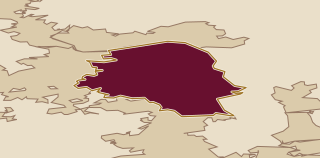
Hangen-Weisheim sits in the Wonnegau area of Rheinhessen, between Alzey and Worms. For Klieber, that location is the address tying the estate’s 21 hectares and its mixed grape range to one part of Rheinhessen, while the labels can still move from dry Riesling to Pinot Noir and cuvées.
The regional directory also names Hangen-Weisheimer Sommerwende and Gundersheimer Höllenbrand in connection with the estate.
In the cellar
Vineyards and cellar
Klieber describes controlled non-intervention as its main winemaking maxim. In wine terms, that is a direction rather than a recipe: it does not establish fermentation vessel, skin-contact time, lees ageing, sulphur regime or maturation length, but it frames the estate’s wish to avoid unnecessary cellar handling.
One later bottle supplies a more tangible cellar detail. The 2024 Pinot Noir was matured in used barriques. Used barrels can bring a gentler oak imprint than new wood, leaving more space for Pinot Noir fruit, body and tannin to show; that detail belongs to the 2024 wine and should not be extended automatically to every Klieber red.
Wines to know
The range in view
The range is built around breadth. Traditional German varieties sit alongside international grapes and cuvées, while the confirmed bottles make the contrast concrete: dry Riesling in white, and varietal Pinot Noir in red. This architecture lets the estate work with citrus-led acidity and dry texture in one wine family, then with Pinot Noir fruit, body and tannin in another.
The 2020 Riesling Trocken is entirely Riesling, and “trocken” establishes a dry finish rather than sweetness. The 2020 Pinot Noir is entirely Pinot Noir, with no sweetness designation supplied. The 2024 Pinot Noir adds the used-barrique detail, introducing oak maturation as a documented part of that particular vintage’s structure.
A useful way in
A bottle to begin with
Start with the 2020 Riesling Trocken. It is a single-variety Riesling made dry, making its role unusually clear: taste the wine for Riesling fruit, acidity, dry texture and finish without cuvée blending or sweetness obscuring the frame. It also sets up the rest of Klieber’s range well, because the same estate then moves outward to Pinot Noir and other traditional and international varieties.