
Why it matters
The producer
The Knewitz family has made wine in Appenheim since the nineteenth century. Tobias Knewitz, who trained at Geisenheim, took over the estate in 2007; his wife Corina and his brother Björn later joined him. The result is a family estate whose dry Rieslings and Chardonnays are tied to named places and distinct cellar treatments rather than presented as one house style.
The modern estate began with a change in how the family’s wine was presented. Gerold Knewitz started estate bottling in 1976 after generations of Knewitz winegrowing in Appenheim. When Tobias took over in 2007, the work expanded into a range where Appenheimer Kalkstein, Hundertgulden and Steinacker each carry a more specific place name.
Place and vineyards
Where the wines begin
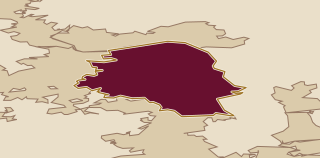
Appenheim sits in the Welzbachtal, a part of Rheinhessen where Knewitz works across three neighbouring communities: Appenheim, Nieder-Hilbersheim and Gau-Algesheim. More than 100 small parcels, bordered by orchards and arable land, break the estate into many growing locations; the range responds with village, vineyard and site names instead of a single regional bottling.
The estate describes cool nights and long growing periods as central features of the valley. For dry Riesling, that pattern supports fruit that can ripen over time while retaining freshness; in the glass, the documented examples move toward citrus, floral and savoury notes rather than broad sweetness.
In the cellar
Vineyards and cellar
Thirty hectares divided across more than 100 parcels demand separate attention in the vineyard. Orchard and arable-land borders surround the vines, while the Welzbachtal’s cool nights extend the ripening period; site selection can therefore carry through to named Riesling bottles rather than disappearing into a blended estate wine.
The cellar work is most clearly documented bottle by bottle. Appenheimer Kalkstein Riesling 2022 has recorded fermentation and ageing details, Hundertgulden Riesling GG 2024 has its own vinification record, and Chardonnay Réserve 2020 has separate élevage evidence. Those individual treatments help explain why the range moves from citrus-led Riesling to a Chardonnay that can show nuttier, grain-like notes as it opens.
Wines to know
The range in view
Appenheimer Kalkstein Riesling 2022 provides the Appenheim-and-limestone frame: a dry Riesling whose name joins village and ground. Its documented tasting material points toward citrus, floral and mineral character, with freshness carrying the wine rather than sweetness.
Hundertgulden Riesling GG 2024 and Steinacker Riesling take Riesling into individual sites. A comparative tasting of the 2015s found Hundertgulden becoming creamier and more open through an evening while staying fresh; the two labels are therefore useful as separate site expressions, not interchangeable versions of the same wine.
A useful way in
A bottle to begin with
Start with Appenheimer Kalkstein Riesling 2022. It puts Appenheim and limestone on the same label, then translates the estate’s dry Riesling work into citrus, floral and mineral notes with a fresh finish. It is a useful first bottle because the village, the soil word and the grape all point in the same direction without requiring a comparison among the individual vineyard wines.