
Why it matters
The producer
Weingut Knipser works from Hauptstraße 47–49 in Laumersheim, a Pfalz village where the family estate makes predominantly dry wines. Volker, Werner and Stephan Knipser run the property, with Stephan in the cellar; that continuity links a nineteenth-century family history to bottles such as Chardonnay Fumé and Dry Riesling. The official estate dates its tradition to 1876, while Wein.plus gives 1874 as the family’s founding year.
The Knipser family came from South Tyrol and first combined vines with fruit and arable farming, selling wine in barrels. The estate became exclusively devoted to viticulture in the early 1970s, then Volker and Werner Knipser began using barriques in the 1980s. That sequence still reads in the Chardonnay Fumé: a Pfalz wine rooted in local limestone yet shaped by small wooden barrels and long contact with its lees.
Place and vineyards
Where the wines begin
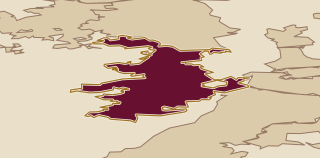
Laumersheim lies in the Pfalz, where Knipser’s vineyards receive less than 500 millimetres of rain annually. This relatively dry setting is part of the estate’s approach to ripe dry wines, while its 2024 Dry Riesling keeps a high, fresh acidity rather than moving toward sweetness. Wein.plus reports that 95% of the estate’s wines are vinified dry, making the word “dry” on the Riesling label a useful guide to the wider house style.
Knipser’s stated vineyard ground includes limestone and loess. The VDP describes limestone as buffering acidity and loess as contributing mineral content; in the 2020 Chardonnay Fumé, the estate narrows that picture further to selected Chardonnay vineyards on limestone and limestone-marl soils. Those sites matter because the Chardonnay’s barrel and lees richness finishes with a chalky edge rather than only butter and oak.
In the cellar
Vineyards and cellar
Knipser says it reduces yields and extends maturation, decisions that concentrate what arrives from the vineyard and slow the wine’s development in cellar. For the 2020 Chardonnay Fumé, the estate selected fruit from its best Chardonnay vineyards, then kept the wine in small wooden barrels for more than a year with particular emphasis on lees ageing. The result is not simply oaky Chardonnay: lees build a creamy texture, while the limestone-based fruit carries smoke, citrus and chalk through the finish.
The 2024 Dry Riesling is 100% Riesling, dry in style, broadly flavoured and marked by high fresh acidity. Riesling’s acidity provides lift and makes it a natural partner for asparagus.
Wines to know
The range in view
The range has two useful poles. Dry Riesling 2024 is the direct, high-acid white: 100% Riesling with broad flavour and a dry finish. Chardonnay Fumé 2020 is the more layered white, built from Chardonnay on limestone and limestone-marl, then given over a year in small barrels and on lees.
Together, the bottles show why Knipser’s dry-wine focus is more than a label claim. Riesling brings citrus-like freshness, acidity and light on its feet; Chardonnay brings more body, creamy lees texture, smoke, hazelnut and fine phenolic grip. One is a grape-led dry white, the other a barrel- and lees-shaped dry white, without either relying on sweetness for weight.
A useful way in
A bottle to begin with
Choose the 2020 Chardonnay Fumé. It is Chardonnay from selected limestone and limestone-marl vineyards, matured for more than a year in small wooden barrels with extended lees ageing. The wine combines smoke, butter, peach, lemon curd and hazelnut with creamy texture, fine phenolic grip and a chalky finish. It comes first because it puts Knipser’s site selection, long maturation and early barrique-minded cellar culture into one dry Pfalz bottle.