
Why it matters
The producer
Weingut Krebs works from Freinsheim in the Pfalz’s Mittelhaardt, farming 20 hectares with Riesling and Pinot Noir as its principal varieties. Organic vineyard certification puts soil and vine care at the centre of the estate’s work; its bottles then carry that fruit through a cellar described as traditional in its foundations and modern in its equipment. Riesling supplies acidity and citrus-led lift, while Pinot Noir—labelled as Spätburgunder in Germany—brings fruit, tannin and body into the range.
Wein.plus dates Harald Krebs’s founding of the winery to 1982. By 2005, Jürgen Krebs had taken responsibility for cellar technology after practical work at other estates and training as a viticultural technician. That sequence keeps vineyard and cellar in close conversation: Harald Krebs remains involved in seasonal work on the soils and vines, while Jürgen’s role concerns the handling that follows harvest. For Riesling, the useful question is how acidity and fruit are carried through the cellar; for Pinot Noir, it is how much body, tannin and oak the wine is asked to take on.
Place and vineyards
Where the wines begin
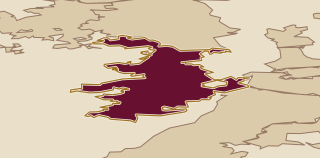
Freinsheim sits in the Mittelhaardt, a named part of the Pfalz that gives a Krebs bottle a more particular address than the regional word Pfalz alone. The 2023 Spätburgunder Gutswein carries Pfalz as its origin and Spätburgunder as its grape, so the label first identifies a regional Pinot Noir rather than a single-vineyard wine. That broad regional frame suits an estate wine: it introduces the grape’s cherry-fruit, acidity and tannin without asking one parcel to speak for the whole cellar.
Around Freinsheim, Krebs works with quartz sand, gravel, loess, clay and limestone. This is not one-soil viticulture: sand and gravel drain differently from clay, while loess and limestone add further variation beneath the vines. The consequence is a vineyard holding that cannot be reduced to a single mineral flavour or texture; Riesling and Pinot Noir are the estate’s two ways of turning that varied ground into bottles with different weight, acidity and grip.
In the cellar
Vineyards and cellar
Certified organic work is a vineyard commitment, and Harald Krebs’s continuing seasonal work includes maintaining soils and vines. Healthy fruit is the practical material behind the estate’s stated aim of joining established quality winegrowing with modern vinification. In the bottle, that approach points toward fruit kept clear enough for Riesling’s acidity and Pinot Noir’s fruit to remain audible, rather than a range defined chiefly by cellar flavour.
The cellar is also described as restrained, an important detail when the range moves from a Pfalz Gutswein to a barrique-matured Spätburgunder. Oak can add body, spice and a broader texture, but it need not erase grape character. Krebs’s documented 2019 Freinsheim trocken “Glimmer” Spätburgunder was matured in barrique, making oak a deliberate part of that wine’s shape rather than a blanket description for every bottle.
Wines to know
The range in view
The range has two principal grape pillars. Riesling offers the white-wine side of the estate, where acidity, citrus and floral notes provide a natural framework for dry Pfalz wine. Pinot Noir provides the red-wine side, from estate-level Spätburgunder to a more cellar-shaped example in “Glimmer.” The contrast is useful because it comes from grape as well as method: Riesling is built around freshness and acidity, while Spätburgunder has tannin, red fruit and body to work with.
The confirmed 2023 Spätburgunder Gutswein is 100% Spätburgunder from the Pfalz. Higher up in the documented selection sits the 2019 Freinsheim trocken “Glimmer” Pfalz Spätburgunder, whose barrique maturation brings oak into the wine’s structure. Read those bottles as different roles rather than interchangeable labels: the Gutswein shows regional Pinot Noir in a direct estate format, while “Glimmer” introduces more oak-derived texture and weight.
A useful way in
A bottle to begin with
Start with the 2023 Spätburgunder Gutswein. It is a Pfalz wine made entirely from Spätburgunder, so the grape, region and estate-level bottle role are all clear before the cork is pulled. Expect Pinot Noir’s red-fruit register alongside acidity, medium body and tannin; that structure makes it a practical way into Krebs’s red-wine work without the added oak dimension of barrique-matured “Glimmer.” It also leaves room to return later for the higher-tier Freinsheim Spätburgunder and notice what oak changes in the texture and finish.