
Why it matters
The producer
At Annagasse 101 in Lengenfeld, Angerer vinifies its own grapes in an estate cellar. The reported 33 hectares include both white and red varieties, so Grüner Veltliner is part of a wider picture rather than the whole operation. That scale, and the reported red plantings including Syrah, explain why the labels work as a way of separating ground and site as much as colour or grape.
Kurt Angerer is the fourth generation to farm the Lengenfeld estate, and the continuity is most visible in a range that carries ground onto the label. Rather than presenting every wine as an isolated cuvée, Kies, Loam and Granit let gravel, loess and primary rock remain part of the bottle’s name. The result is a line-up in which a Grüner Veltliner can be read through site as well as grape, while the estate’s red plantings prevent the story from narrowing into a white-wine-only account.
Place and vineyards
Where the wines begin
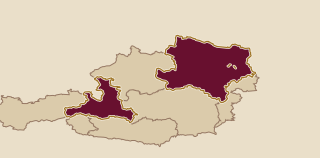
Western Kamptal brings warmth to Angerer’s south- and southwest-facing sites, while the hills send cooler air down at night during hot summer weather. The estate connects those night winds with fruit and aroma development: grapes can ripen through the day without the nights simply repeating the heat. In a dry Grüner Veltliner such as Kies, that day-and-night pattern matters because fruit ripeness still has to sit alongside acidity.
Primary rock, deep loess and gravel all appear in Angerer’s vineyards. They are not decorative details in the background of the range: Kies refers to gravel, Loam to deep loess, and Granit to primary rock. A bottle name therefore points back to physical ground before the cork is pulled. The names Spies and Eichenstaude also refer to soil types or vineyard sites, keeping the range rooted in where the vines stand.
In the cellar
Vineyards and cellar
The vineyards combine Austrian and international varieties, with reported red acreage that includes Syrah. That mixed planting gives the cellar fruit with different needs, and vinification takes place on the estate rather than elsewhere. For Kies Grüner Veltliner, a retailer’s 2025 material records fermentation and partial malolactic conversion; the documented analytical profile of the 2023 shows a dry wine with less than 3 grams per litre of sugar and 4.8 grams per litre of acidity. Those are useful signs of a wine shaped for freshness without residual sweetness.
Wines to know
The range in view
Angerer’s named range is arranged around site and soil markers: Kies, Spies, Loam, Granit and Eichenstaude. Kies belongs to the current Grüner Veltliner offering and is the most fully documented bottle here: the 2023 is 100% Grüner Veltliner, dry at less than 3 grams per litre of sugar, with acidity listed at 4.8 grams per litre. Its structure is therefore not built on sweetness; acidity carries the palate and keeps the fruit in a dry frame.
The rest of the range should be approached as a set of place names rather than assumed grape recipes. Gravel, loess and primary rock point to the ground beneath particular vines, while Angerer’s substantial red-variety plantings show that the estate’s work extends beyond Grüner. That split between a clearly documented dry white and a broader red-and-white vineyard holding is the useful way into the bottles.
A useful way in
A bottle to begin with
Choose Kies Grüner Veltliner 2023. It is a 100% Grüner Veltliner and a direct link between a named soil reference—Kies, or gravel—and a current white-wine bottling. Less than 3 grams per litre of sugar keeps it dry; 4.8 grams per litre of acidity supplies shape and a brisk finish. It also avoids a common shortcut: Angerer is not presented as only a Grüner specialist, yet this bottle makes the estate’s site-led naming easy to grasp in the glass.