
Why it matters
The producer
The family history reaches back to 1770, making the estate one of Südsteiermark’s longstanding names. Its present work is tied to a compact practical fact: the vines, grapes and wines stay under one roof. Estate-grown Sauvignon Blanc, Gelber Muskateller, Welschriesling, Pinot Blanc, Chardonnay and Pinot Gris can therefore be separated by grape and site instead of assembled from bought fruit.
Katharina Tinnacher took over in 2013. Her move toward wholly organic cultivation sits alongside a collection built bottle by bottle, from aromatic Gamlitz wines to Sauvignon Blanc with longer large-wood maturation. The result is a range where the variety is still clear, while élevage can add weight and a longer finish.
Place and vineyards
Where the wines begin
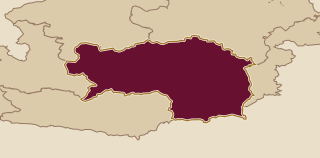
Steinbach sits near Gamlitz in Südsteiermark, a hilly southern Austrian wine region where vineyard height matters. Lackner-Tinnacher’s warm, sheltered sites run from 320 to 550 metres: daylight and exposure ripen grapes, while cool air moving through the hills preserves acidity. In the glass, that combination supports yellow and tropical fruit without pushing the wines toward heaviness.
The estate is located on a ridge near Gamlitz, with steep vineyard ground around it. Sauvignon Blanc here can move from gooseberry and herbs toward citrus and riper fruit, depending on the bottle and ageing; Gelber Muskateller carries floral perfume and grapefruit zest with a dry, compact palate.
In the cellar
Vineyards and cellar
The estate selects grapes carefully, presses them gently and ferments the selected must entirely with spontaneous fermentation. It also avoids fining and additives. These choices do not promise one fixed flavour across every bottle; they allow grape, vintage and ageing vessel to remain audible, from floral Muskateller to the savoury, longer-aged Sauvignon Blanc.
The cellar handling is especially useful when comparing the Sauvignon Blancs. Ried Welles 2019 spent 18 months in large wood, and its honey, tobacco and caramel notes show a more developed oak-and-ageing frame around ripe fruit.
Wines to know
The range in view
The range begins with aromatic varieties and extends into Sauvignon Blanc and white Burgundy grapes. Gamlitz Gelber Muskateller is the clearest light-footed expression: six months in steel for the documented 2023, with floral aromas, yellow tropical fruit, grapefruit zest, fresh acidity and fine tannin. Its salty finish makes it a dry table wine rather than merely a perfume-driven aperitif.
Gamlitz Sauvignon Blanc adds more cellar shape. Tangerine zest, gooseberry, herbal savouriness and white tropical fruit meet lively acidity, while the steel-and-large-wood élevage brings more body than the Muskateller. Ried Welles Sauvignon Blanc moves further toward depth: 18 months in large wood support blossom honey, tobacco, caramel, lychee, citrus and a longer finish.
A useful way in
A bottle to begin with
Choose Gamlitz Gelber Muskateller. The documented 2023 is a dry varietal wine matured for six months in steel, so it brings the estate’s elevated sites and low-intervention cellar into focus without the added frame of long wood ageing. Expect flowers, yellow tropical fruit and grapefruit zest, followed by fresh acidity, fine tannin, compact body and a salty finish. It is the most immediate way into Lackner-Tinnacher’s combination of ripe fruit, dry structure and estate-grown clarity.