
Why it matters
The producer
Franz and Barbara Leth began the estate in the 1960s; their grandson, Franz Leth Junior, now leads it. Grüner Veltliner is the central grape, with Roter Veltliner and Riesling alongside it, and the winery is part of Österreichische Traditionsweingüter. That family continuity appears in a range built around one local variety: a light Grüner can show pear, herbs and lime, while a named Fels vineyard such as Brunnthal can carry more yellow fruit and weight.
The family estate has expanded across three generations, but a more recent turn was its move to organic certification. Falstaff reports that the family tested organic cultivation for more than a decade before the entire estate became certified organic with the 2021 harvest. The work includes no herbicides or insecticides, alongside biodiversity measures and responsible resource use. That decision sits behind a Grüner Veltliner programme in which fruit is picked by hand in several passes rather than gathered as one uniform crop.
Place and vineyards
Where the wines begin
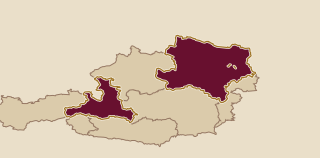
Fels am Wagram sits in Lower Austria’s Wagram region, where loess is the defining ground beneath many vineyards. For Leth, the regional name matters most through Grüner Veltliner: the estate uses it for summer wines, Klassik wines and single-vineyard bottlings, allowing the same grape to change shape as the label becomes more site-specific. Brunnthal, a Fels single-vineyard Grüner, is the clearest example, with a fuller yellow-fruit profile than the regional 2025 Leth Grüner Veltliner.
Wagram’s loess was deposited by glacial winds over an ancient Danube rock base and can reach 20 metres deep. Brunnthal has deep, chalk-rich loess, and Leth links this soil to the wine’s density. In the glass, that site is described through pronounced yellow fruit and pepper spice rather than through a vague promise of place: the ground is relevant because the Brunnthal bottling has a broader, more substantial palate than a simple fresh Grüner.
In the cellar
Vineyards and cellar
Leth limits yields, manages the canopy in detail and harvests exclusively by hand through several selective passes. Those choices allow different ripeness levels in Grüner Veltliner to be sorted in the vineyard before the wine reaches the cellar, helping preserve both ripe fruit and acidity. The cellar then separates the range by purpose: the 2025 regional Grüner is fermented at low temperature in stainless steel, while Falstaff reports that top-site wines spend at least a year in large traditional wooden barrels. The 2022 Brunnthal spent 11 months in large wood, adding texture without turning its apricot and pepper notes into an oak-led wine.
Wines to know
The range in view
The range begins with light, fresh, aromatic summer wines, then moves to Klassik bottlings intended to show a clear varietal Grüner Veltliner character, before arriving at individual vineyards. Roter Veltliner and Riesling broaden the white-wine selection, while the reds take either a fruity classical direction or a more powerful reserve style.
Within Grüner Veltliner, the structural shift is easy to follow. The 2025 Leth Grüner Veltliner is a stainless-steel wine with pear, honeydew melon, herbs, white pepper and lime; its light body and acidity suit the early, fresh end of the range. Brunnthal is the site-focused step upward: the documented 2022 showed ripe yellow tropical fruit, apricot, mango, blossom honey, herbal savouriness, stone fruit, fine acidity, silky texture and a mineral finish.
A useful way in
A bottle to begin with
Choose Grüner Veltliner Fels Ried Brunnthal. It is a single-vineyard Grüner from deep, chalk-rich loess in Fels, and it brings Leth’s place, farming and cellar choices into one bottle. The 2022 showed apricot, mango, stone fruit, blossom honey and delicate herbal savouriness, with fine acidity beneath a silky, mineral palate. Eleven months in a large wooden barrel supplied breadth and texture, while pepper spice and yellow fruit kept the vineyard at the centre. Begin here when the aim is to taste how Leth moves beyond a fresh regional Grüner without losing the grape’s dry, peppery line.