
Why it matters
The producer
Nastl joins a long family record to a working estate in Langenlois rather than treating the 1656 date as decoration. The present family divides the work across vineyard, cellar and hospitality, and Christian’s cellar role gives the wines a direct link between the fruit grown with Günter and the bottles released under the estate name. A family Heuriger has also operated in Langenlois for more than 60 years, putting the wines alongside food and a local table.
Christian Nastl returned to the family estate after periods in Germany, the United States and New Zealand. He now takes responsibility for the cellar, bringing those years abroad into a winery whose family record begins in seventeenth-century Langenlois. The result is not a break with the estate’s past, but a present-day cellar run by a family member who has seen vineyards and wineries beyond Kamptal.
Place and vineyards
Where the wines begin
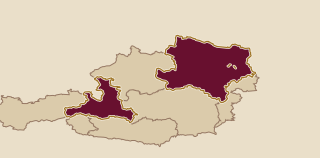
Langenlois sits in Kamptal, in Lower Austria, and that regional address appears on the estate’s NastlKamptalDAC wines. Kamptal DAC is the designation carried by these regionally defined bottlings, so the label points back to Kamptal rather than simply to a family range name. Grüner Veltliner is central to the estate’s work, while Riesling and Zweigelt extend the grape palette from white wine to rosé and red.
Steinmassl, Kittmannsberg, Spiegel, Käferberg and Liss are the vineyard names Nastl places beneath its wines. Those names give the estate several distinct geographical anchors within Langenlois; Kittmannsberg, for example, appears with a 2022 Grüner Veltliner Kamptal DAC.
In the cellar
Vineyards and cellar
Günter and Christian Nastl jointly work the vineyards, while Christian receives the fruit in a three-storey cellar designed to let grapes move by gravity. Stainless-steel tanks occupy the upper level, with passages leading onward to a wooden-barrel cellar and vinotheque described as 300 years old. The building gives steel-fermented wines such as the Zweigelt Rosé a direct route from fruit handling to lees ageing, while retaining space for barrel work.
Nastl has held Nachhaltig Österreich certification since 2016. Falstaff classifies the 12 hectares as conventionally farmed, so the useful description is certified sustainable practice within conventional farming, rather than an organic or biodynamic claim.
Wines to know
The range in view
The published range has four working names. NastlFruchtig is the fruit-led section and includes the documented Zweigelt Rosé; NastlKamptalDAC contains wines carrying the Kamptal regional designation; NastlExklusiv and NastlRot complete the estate’s named offer. Together they move between fresh, early-drinking fruit expression and wines defined by regional designation or red-wine focus.
Above that structure sits Gigant, a reserve category containing Grüner Veltliner, Riesling and Zweigelt. It gives the estate a place for three grapes in more concentrated reserve bottlings, while the rosé shows what happens when Zweigelt is picked and handled for a lighter-bodied, stainless-steel-raised wine instead of a red.
A useful way in
A bottle to begin with
Start with the Nastl Zweigelt Rosé, preferably a vintage for which the estate’s technical details are available. It is 100% Zweigelt from deep, fertile loess, with eight hours of press contact, stainless-steel fermentation and fine-lees ageing. Expect raspberry, strawberry and sweet cherry, carried by refreshing acidity and a light, juicy body. It comes first because it makes the cellar choices easy to taste: short skin contact supplies the rosé character, steel keeps the fruit clear, and lees add a little breadth to the finish.