
Why it matters
The producer
Weingut Nik Weis – St. Urbans-Hof is a Leiwen-based family estate whose Riesling range runs from wider estate bottlings to wines from villages and classified individual crus. Nicolaus Weis founded it in 1947; Hermann Weis took over in the 1960s, and Nik Weis joined in 1997. The name refers to Saint Urban, patron saint of winegrowers, while the bottle language is firmly geographical: a label can move from broad estate origin to a village or a single Great Site.
Nik Weis arrived at the winery in 1997 and reshaped the holdings with his father by selling lesser sites and acquiring better parcels. For a Riesling estate spread across two river regions, that was a practical decision about what fruit would enter the cellar. The later range is therefore built around chosen origins: broader Estate Wines, village-labelled bottlings and individual Great Site wines, rather than an undifferentiated collection of vineyard land.
Place and vineyards
Where the wines begin
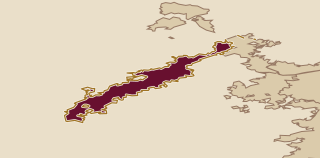
The estate’s vineyards extend along both the Mosel and Saar for about 60 kilometres. That spread matters at the label: Estate Wine gives a broader view of the cellar’s Riesling material, Village Wine narrows the origin to one village, and Great Site wine names an individual classified cru. The result is not one interchangeable Mosel Riesling, but a range in which the stated origin becomes more specific as the classification rises.
The estate’s physical frame is its reach across the Mosel and Saar. Its five VDP.Grosse Lage crus sit at the most site-specific end of the range, while the estate and village levels carry broader origins. That scale changes how to read the bottle: the classification tells how narrowly the Riesling’s source has been defined, without asking the wine to speak for an entire river region.
In the cellar
Vineyards and cellar
The estate describes its approximately 45 hectares as traditionally cultivated in harmony with nature. Its work also includes a vine nursery and historic Riesling genetics, tying current vineyard material to a longer family practice with the grape. In the cellar, fermentation with indigenous yeasts keeps the starting point close to the harvested must rather than a selected commercial culture. These choices place Riesling fruit, its acidity and its degree of sweetness at the centre of the finished wine rather than relying on a heavy-handed cellar signature.
Wines to know
The range in view
The black-and-white label system is the useful route through the range. Estate Wines are the broadest level; Village Wines put a named village in focus; Great Site wines come from individual classified crus. Riesling carries that progression through differences of origin, sweetness and structure. Three 2024 Rieslings show variation across those dimensions, so the range is more than a ladder of labels: sweetness, acidity, body and texture are part of how each level lands on the palate.
Start with the aroma, where Riesling commonly offers fruit or floral notes before the palate reveals its sweeter or drier direction. Here, sweetness and structure vary among the 2024 wines. On the palate, acidity is the key counterweight: it can keep a sweeter Riesling lively, or make a drier wine feel more direct and mouthwatering. Notice the body and texture through the middle of the sip, then whether fruit, mineral notes or a savoury edge remains in the finish.
A useful way in
A bottle to begin with
Start with a current Estate Wine Riesling in the estate’s black-and-white label system. It is the broadest origin level, so it introduces the producer’s central grape before village and classified-cru distinctions become the main subject. Look for Riesling fruit, bright acidity and the sweetness indication carried by that particular bottling; then use its body, texture and finish as a reference when moving up to Village Wine or Great Site labels.