
Why it matters
The producer
The name above the cellar in Cortina sulla Strada del Vino is the same as it was in 1928, but the line that carries it bent sharply in 1969 when the founder died young and the estate passed to a nephew who had not prepared for it. Helmut Zemmer ran it, and then handed it to his son Peter, who leads it today in its third generation.
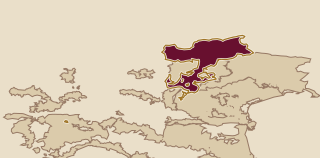
The estate sits in the heart of the Alto Adige wine corridor, the province that occupies the upper Adige valley in the far north of Italy, where German is as common as Italian and the mountain walls on either side push viticulture to elevations that would be impossible in Piedmont or Tuscany. Peter Zemmer works with white Burgundy varieties at the core of the range alongside Lagrein, an indigenous Alto Adige red, and Pinot Noir. The altitude differential across the estate's vineyards is 800 metres, from 220 metres at the valley floor to 1,030 metres at the Koflhof vineyard above. Few estates in the region farm across a vertical span that wide.
Place and vineyards
Where the wines begin
Cortina sulla Strada del Vino, also known as Kurtinig an der Weinstrasse in German, sits on the Wine Road that runs through the central Alto Adige corridor. This stretch of the Adige valley is the main white-wine belt of the province: wide enough to receive good sunlight, protected enough by the surrounding peaks to hold warmth through the growing season, with Alpine air pushing freshness and acidity into the fruit.
The broad geology of the central Alto Adige corridor includes glacially deposited alluvial material on valley floors, with steeper slopes carrying older rock. The altitude gradient across the estate means the Koflhof parcels near 1,030 metres experience considerably shorter growing seasons, lower average temperatures, and stronger diurnal swings than the lower valley sites. These thermal differences shape the fruit directly: slower accumulation of sugar and longer hang time at elevation, which translates into firmer acidity and more defined aromatics in the finished wine.
In the cellar
Vineyards and cellar
Yield reduction and manual work through the season are central to the estate's declared approach. Fertilizers and pesticides are kept to a minimum across the range, with hand work used at most stages of the growing cycle. The producer frames the wine's character as vineyard-formed: selection in the vineyard is the prerequisite before cellar work begins.
After harvest, fine-lees maturation is used for the range as a whole. Leaving wine in contact with the spent yeast cells after fermentation develops texture and rounds the acidity without adding sweetness; fine-lees maturation develops balance and texture. For the single-vineyard Riserva tier, both large and small oak barrels are used during ageing. The larger barrels add oxygen exposure without heavy oak flavour; smaller barrels integrate more wood tannin and build body over longer ageing periods.
Wines to know
The range in view
The range divides clearly along altitude lines. The variety-labelled wines, including Chardonnay, Pinot Blanc, and Pinot Grigio, draw from lower-elevation parcels and are built for early drinking: fresh, direct, and cleanly varietal. Pinot Grigio at this elevation in Alto Adige tends toward savory and mineral rather than the pale and neutral style common in flatter zones; Pinot Blanc carries a rounder mid-palate and a gently almond-inflected finish.
The Riserva tier is a different proposition. Furggl is the estate's flagship red, made from Lagrein, Alto Adige's indigenous dark-skinned grape. Lagrein produces deeply coloured, tannic wines with earthy depth and dark fruit, and Furggl carries that character: blackberry, stony minerality, black licorice, loam, and black olive in the aromatic register, with persistent dusty tannins on the finish. It is not a soft wine.
A useful way in
A bottle to begin with
Start with Furggl, the Lagrein Riserva. Lagrein is native to Alto Adige and found almost nowhere else in serious winemaking; drinking Furggl is one of the few routes into the grape at Riserva level. The 2018 opened with blackberry, black licorice, stony minerality, loam, and black olive, moving into a long finish of dusty, persistent tannins. There is real weight here, and real depth. Oak ageing in both large and small barrels adds body and integration without masking Lagrein's earthiness. It is not a light or easy wine, and it should not be; come to it with a few years of age on it, or pair it with something substantial.