
Why it matters
The producer
Wine has been part of the Grassl family’s activities since the 18th century, but the first recorded bottling came in the 1950s. Philipp Grassl took over after 2006, bringing a later generation to a family estate whose wines now move from a Carnuntum Zweigelt to layered blends. Göttlesbrunn is the fixed point: it is where the family farms its red grapes and where the names Rubin Carnuntum, Neuberg and Bärnreiser take their place in the range.
The long Grassl family history is not presented as an unbroken line of estate bottlings. Wine activity reaches back to the 18th century, while bottling under the family name is recorded from the 1950s. After Philipp Grassl took over, the vineyard programme changed in dated steps: the estate moved fully to organic farming in 2015 and added biodynamic techniques from 2019. Those decisions matter because Rubin, Neuberg and Bärnreiser are not simply labels in a red-wine portfolio; they come from vineyards managed through a specific shift in farming.
Place and vineyards
Where the wines begin
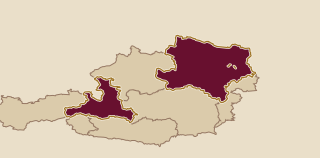
Göttlesbrunn provides the estate’s home, while Carnuntum appears directly on the Rubin Carnuntum label. That distinction is useful in the glass: Göttlesbrunn names the producer’s base, while Carnuntum identifies the wider wine place attached to its Zweigelt-led Rubin. Rather than treating the region as decoration, Grassl uses it on a wine that has remained in the market for 30 years and developed into a house classic.
The estate does not need invented hillside drama to explain its vineyard work. Its vines are dry-farmed and planted with legume and clover cover crops, which means the ground between rows is actively managed rather than left bare. That choice puts farming at the centre of the red wines: Zweigelt, Blaufränkisch and St. Laurent are grown in vineyards where water use and living cover are part of the annual work.
In the cellar
Vineyards and cellar
Organic certification, dry farming and cover crops establish the vineyard framework before grapes reach the cellar. Biodynamic techniques have been used since 2019, extending that work beyond the certified organic conversion. In the cellar, the wines remain distinct rather than being treated as one generic red: Neuberg 2023, Bärnreiser 2023 and Rubin Carnuntum 2024 each have their own vinification and maturation details. The consequence is a range built bottle by bottle, with Zweigelt leading Rubin and the blends taking different positions through body, tannin and weight.
Wines to know
The range in view
Rubin Carnuntum is the anchor wine: a Zweigelt-led Carnuntum red that has been on the market for three decades. Philipp Grassl has described its style as moving away from a heavier expression, so Rubin belongs at the fresher, more direct end of the estate’s red architecture rather than being treated as an oversized reserve wine. Neuberg sits above that starting point as Bärnreiser’s more approachable counterpart, while Bärnreiser is the red blend for a slower look at the estate’s more substantial side. Blaufränkisch and St. Laurent widen the grape foundation beneath these wines, keeping the range rooted in Austrian red varieties rather than one grape alone.
A useful way in
A bottle to begin with
Start with Rubin Carnuntum. It is the estate’s Zweigelt-led Carnuntum wine, has a 30-year history in the range, and reflects Philipp Grassl’s stated move away from a heavier style. Expect a dry red with fruit at the front, moderate weight, acidity to keep the palate moving and tannin that adds grip through the finish. It comes first because it connects the Göttlesbrunn estate, Carnuntum on the label, Zweigelt in the vineyard and the family’s most established house wine in one bottle.