
Why it matters
The producer
Stefan Pratsch, born in 1985, studied at the viticultural school in Mistelbach before learning in his parents’ winery. The estate works about 20 hectares of its own land and grapes from contract partners farming about 30 more; its own vineyards are separated in the WINE BY S. PRATSCH mark. Grüner Veltliner is the central grape, while Riesling, Sauvignon Blanc, Zweigelt, Sankt Laurent, Traminer and Bordeaux varieties widen the range.
The present winery grew from the union of two long-established Hohenruppersdorf winegrowing families. Willi Pratsch introduced organic vineyard cultivation, and Stefan’s training added a formal viticultural grounding to work learned at home. That family sequence now appears in a range that can place a light Grüner beside a site-labelled wine or a long-macerated Traminer without losing the connection to the village.
Place and vineyards
Where the wines begin
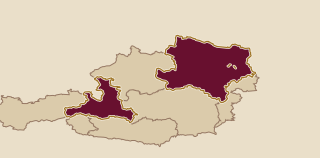
The cellar stands at Milchhausstrasse 5 in Hohenruppersdorf, Weinviertel. On a Weinviertel DAC Grüner Veltliner label, the appellation narrows the wine to the region’s signature grape: Pratsch describes its version through pepper and spice, with loess contributing flavour and fragrance. The result is a dry white whose regional name is useful information in the glass, not just an address.
Pratsch’s Single Vineyard wines separate vineyards rather than treating Grüner Veltliner as one uniform style. Heiligenberg faces south and is exposed to wind; its loess, loam and humus-rich layers underpin a Grüner Veltliner the winery calls powerful, dense, deep and fine-mineral. Rotenpüllen is also south-facing, but its lower section cools at night and combines red gravel, loess, loam and limestone, leading to a spicy, mineral expression.
In the cellar
Vineyards and cellar
Organic farming at Pratsch includes cover crops, natural fertilisers and careful vine work. High, sun-exposed Guyot Double trellising raises the fruiting zone, helping grapes ripen while regional winds help keep them dry and healthy. Riper, sound fruit supports the fuller texture of the estate’s site and Reserve wines.
In the cellar, temperature control and hygiene protect aromatic fruit. Fine white wines mature on lees in steel, building texture without an overt oak flavour; deeper wines can go into wooden barrels. Some fermentations begin spontaneously with yeast from ripe grapes, while the winery uses pea and potato products rather than gelatine for vegan wines. Traminer Erdverbunden takes the most extended route: about eight weeks on skins, then ageing in 500-litre acacia barrels, for a more savoury, textured white.
Wines to know
The range in view
Classic is the lighter end of the range, with Grüner Veltliner, Weinviertel DAC Grüner, Sauvignon Blanc, Zweigelt and Zweigelt rosé. The 8% Grüner keeps the grape’s spice at lower alcohol, while the standard DAC Grüner brings pepper, spice, dry acidity and modest body. Frizzante Rosé, made from Zweigelt and Sankt Laurent, shifts the focus to mousse: Brut is fresh-fruited with a fine, creamy texture, while Extra Brut is drier.
Single Vineyard wines put a named site beside the grape. Grüner Veltliner Heiligenberg is dense and mineral; Grüner Veltliner Rotenpüllen is spicy and mineral; Riesling Heiligenberg combines fruit with mineral notes. Site wines also include Zweigelt, Sauvignon Blanc and Sankt Laurent, whose dark, humus-rich soil is linked to fruit and depth.
A useful way in
A bottle to begin with
Start with Grüner Veltliner Heiligenberg 2023. It is a 13% alcohol Grüner from south-facing Heiligenberg, grown on loess, loam and humus-rich soil, with 6.5 g/l acidity and 3.8 g/l residual sugar. The wine is powerful, dense, deep and fine-mineral: a dry white with enough acidity to carry its weight and a mineral finish that ties the grape to one named vineyard.