
Why it matters
The producer
The Rings family moved from mixed fruit growing and bulk wine into estate bottling when Steffen Rings made his first wine in 2001. His brother Andy returned in 2007 after training at Wagner-Stempel in Siefersheim. Steffen now oversees the vineyards and Andy is chief winemaker, a division that connects each named site to decisions in the cellar. Rings joined the VDP in 2015, while its bottles remain rooted in Freinsheim and the neighbouring vineyard villages.
The estate’s change was practical before it became stylistic. The family’s earlier business combined fruit growing with bulk wine; Steffen’s 2001 first wine began a move toward bottling under the Rings name and separating vineyards into individual wines. Andy’s return in 2007 added cellar experience from Wagner-Stempel, so the new direction had both a vineyard hand and a winemaker behind it. The consequence is a range where Riesling and Spätburgunder are not treated as generic Pfalz grapes, but as vehicles for named sites and differing élevage.
Place and vineyards
Where the wines begin
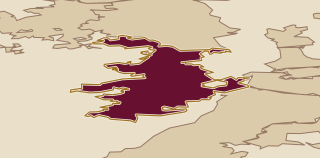
Freinsheim lies about 10 kilometres north of Deidesheim in the northern Mittelhaardt, a part of Pfalz where Rings can work several distinct vineyard addresses without leaving its local orbit. Saumagen and Steinacker are in Kallstadt, Schwarzes Kreuz is in Freinsheim, Weilberg in Ungstein and Felsenberg in Leistadt. This spread matters in the glass: a label bearing Steinacker points to a particular Kallstadt site, while the wider range can move between village wines and more site-focused bottlings.
Limestone and lime-marl run through important Rings ground, including Saumagen, Steinacker and Kalkofen. Kallstadter Steinacker is especially useful for understanding the red wines: it is a cool site influenced by the Palatinate Forest, with very dry calcareous soil. Spätburgunder from such ground can carry freshness and mineral drive alongside ripe fruit, rather than relying on oak alone for shape.
In the cellar
Vineyards and cellar
Rings is moving toward certified organic cultivation, a farming direction applied across vineyards that range from Kallstadt’s dry limestone to sites around Freinsheim, Ungstein and Leistadt. In the cellar, Riesling ferments spontaneously and remains on lees in large traditional wooden barrels. Spontaneous fermentation can retain a site-led fruit profile, while lees ageing builds texture and softens the line of dry acidity without adding overt new-oak flavour.
The Spätburgunder programme takes a different route. Pinot Noir is fermented spontaneously, matured in French oak and bottled without filtration. French oak supplies frame and spice, while unfiltered bottling preserves more of the wine’s material on the palate; on a cool calcareous site such as Steinacker, the intended balance is red fruit, mineral freshness and tannin rather than soft, sweet fruit alone.
Wines to know
The range in view
The portfolio is divided roughly evenly between white and red wines, with Riesling and Spätburgunder at its centre. Village wines offer the estate’s broader Pfalz expression, while wines marked by sites such as Steinacker put a named parcel closer to the foreground. The official Pinot Noir range includes village, Erste Lage and Grosses Gewächs wines, so the hierarchy is a guide to origin rather than a claim that one bottle replaces the rest.
Riesling brings dry acidity, citrus fruit and lees-derived texture from its large-wood élevage. The red range moves from lighter Pinot Noir expressions toward site bottles with more tannin, weight and French-oak structure. The 2023 Kallstadter Steinacker Spätburgunder 1G is a documented example: a site-labelled Pinot Noir from dry calcareous soil, spontaneously fermented, raised in French oak and bottled unfiltered.
A useful way in
A bottle to begin with
Start with the 2023 Kallstadter Steinacker Spätburgunder 1G. It joins a named Kallstadt vineyard to a clear set of choices: Spätburgunder from a cool, very dry calcareous site, spontaneous fermentation, French-oak ageing and unfiltered bottling. Expect red fruit, mineral freshness, firm but measured tannin, medium-bodied weight and a long finish. It comes first because its label, soil and cellar method can all be read directly through one bottle.