
Why it matters
The producer
Rudi and Christiane lead Rabl, where a long family history now meets a defined division of work. Johanna and Tobias joined in 2023; Johanna handles marketing, logistics and sales, while Tobias concentrates on cellar work. That arrangement keeps the bottle connected to both the Langenlois vineyard holdings and the cellar decisions that shape its fruit, texture and finish.
Winegrowing was recorded here in 1750, but the modern family sequence has clear dates. Rudolf Rabl Sr. took over the business in 1975; Rudolf Jr. joined in 1986 and became responsible for vinification. The estate has since grown into an 80-hectare Langenlois operation whose named vineyard wines place cellar work alongside a much wider collection of sites than a single-vineyard domaine could offer.
Place and vineyards
Where the wines begin
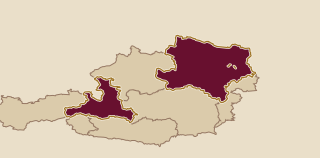
Langenlois is the estate’s home in Lower Austria, and Kamptal DAC appears on the labels of both Riesling Steinhaus Rote Erde 2023 and Grüner Veltliner Ried Käferberg Alte Reben 2023. The appellation, grape and vineyard name sit together on those bottles, so the label distinguishes a Riesling from Steinhaus from old-vine Grüner Veltliner from Käferberg before the cork is pulled.
The useful site fact at Rabl is the breadth of named holdings rather than an unsupported claim about one soil or slope. Käferberg and Steinhaus already appear in named wines, while Kittmannsberg, Liss, Schenkenbichl, Spiegel, Steinmassl and Weißes Kreuz extend the estate’s vineyard vocabulary. That site structure allows grape and place to change together across the range, rather than reducing every white to one house style.
In the cellar
Vineyards and cellar
Rabl has held Sustainable Austria certification since 2015, making vineyard practice part of the estate’s documented work rather than a label decoration. In the cellar, spontaneous fermentation, extended skin maceration and fermentation at 20–21°C are regular practices. Spontaneous fermentation can broaden texture, while time on skins can add phenolic grip; together they give dry Grüner Veltliner and Riesling more shape through the middle of the palate than fruit alone would provide.
Wines to know
The range in view
The range is best read through three bottles with different jobs. Grüner Veltliner Kamptal DAC Ried Käferberg Alte Reben 2023 joins an old-vine designation to a named site, bringing Grüner’s dry body, acidity and savoury grip into a vineyard-specific wine. Riesling Steinhaus Rote Erde Kamptal DAC 2023 shifts the focus to Riesling and Steinhaus, where citrus and stone-fruit character can sit on a firmer acidic line and a mineral finish.
Gelber Muskateller 2025 takes the range in another direction. Its aromatic grape character brings floral fruit and perfume, while its documented acidity and residual sugar give the palate a different balance from the dry Kamptal DAC wines. Together, the three bottles show a range built through grape, site and structure: old-vine Grüner Veltliner for weight and grip, Riesling for dry acidity, Muskateller for scent and softer sweetness.
A useful way in
A bottle to begin with
Start with Riesling Steinhaus Rote Erde Kamptal DAC 2023. It names the grape, the Kamptal appellation and the Steinhaus site in one bottle, while its dry acidity, citrus fruit and mineral finish keep the wine clear on the palate. Riesling is especially useful here because the label’s place information is matched by a direct sensory shape: fruit at the front, acidity through the middle, and a firm finish that invites another look at the site name.