
Why it matters
The producer
The Sander family had already begun selling bottled wine by 1925; today Stefan Sander is the named winemaker in Mettenheim. The estate’s working history runs through three generations: Ottoheinrich began converting the vineyards to organic cultivation in the 1950s, Gerhard developed those methods further, and Stefan has shaped the current wines. That continuity matters most in bottles such as the Riesling trocken, where a long-held vineyard approach meets a plainly dry, fruit-led style rather than a sweetened profile.
Sander’s story begins with bottles as well as vines. The family was selling its own wine by 1925, then Ottoheinrich turned the vineyard work towards organic cultivation in the 1950s. Gerhard refined the methods before Stefan developed the present wine style, linking successive decisions to a range that now includes dry Riesling, lees-aged Silvaner, sparkling Riesling and Spätburgunder. The small ladybird on Sander labels belongs to that vineyard picture: it refers to beneficial insects cultivated among the vines.
Place and vineyards
Where the wines begin
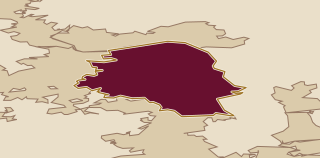
Mettenheim is Sander’s base in Rheinhessen, and the place appears on the page as the estate’s physical address rather than as a catch-all flavour claim. A bottle such as Sander Riesling trocken names the grape first and the dry style second: Riesling supplies the apple, pear and lime register, while trocken signals that its small amount of residual sugar is held within a dry frame. The result is a white wine whose fruit is present without becoming heavy.
The vines grow on fertile loess soils around Mettenheim. Sander names Schloßberg, Michelsberg and Geyersberg among its top vineyard sites, but does not attach a separate tasting profile to each one here. What is documented is the shape of the best sites: they escaped official land consolidation, leaving hedges, banks, walls and green cover in place. Those features remain wildlife habitat around the vines, while the bottles keep their site references from becoming unsupported flavour shorthand.
In the cellar
Vineyards and cellar
Organic cultivation is the estate-wide thread, with hedges, banks, walls and green cover retained in its best vineyards as habitat. In the cellar, the most detailed example is the 2025 Silvaner: after an 18-hour cold maceration, it ferments at a controlled 20°C and matures on its lees. Cold skin contact and lees ageing provide a practical route from grape to glass, and the finished wine is described as light, dry, fruity and gently spicy rather than broad or oak-driven.
Wines to know
The range in view
The range is organised by wine type and grape. Sander Riesling trocken 2025 is a still, varietal Riesling with very low sugar and a fresh dry profile. Sander Silvaner 2025 offers a lighter white wine, with gooseberry, quince and white peach alongside spice and pleasant acidity. Prestige Cuvée Riesling Brut 2024 takes Riesling into sparkling form: dry, fresh and built around green apple, biscuit, white peach, mineral notes, honey and lime.
The listed Sander Spätburgunder 2021 supplies a red-wine branch to the range and is made from 100 percent Spätburgunder. No tasted description is available for that bottle, so its fruit, tannin, body and finish should not be guessed from the grape name alone. The contrast is useful nonetheless: Riesling carries the estate’s brightest citrus-and-acidity expressions, Silvaner brings a milder, lightly spicy texture, and Spätburgunder changes both colour and grape without a manufactured tasting claim.
A useful way in
A bottle to begin with
Start with Sander Riesling trocken 2025. It is varietal Riesling in a dry style, with only 0.5 g/100 ml sugar, so its pear, green apple, honeydew melon and pineapple aromas are carried by fresh acidity instead of sweetness. White flowers, lime and a mineral note add lift through the palate, and the finish stays dry. This bottle comes first because it joins the Mettenheim estate, its core grape and its most fully documented taste profile in one straightforward glass.