
Why it matters
The producer
Weingut Sebastian Erbeldinger works as Bastianshauser Hof, a family estate among the vineyards of Bechtheim-West. Its story begins in 1899, when an ancestor named Sebastian Erbeldinger settled there, and gained a fixed home in 1935 when his son Jakob acquired the present property. Today the estate’s Riesling-led range carries that family thread into bottles made from vineyards around Bechtheim-West and neighbouring Rheinhessen communities.
The current cellar work joins generations. Ilke and Ralf took over in 1991, while Sebastian junior brought winegrowing training, viticulture studies and experience in South Africa, New Zealand, Nepal and Australia before taking shared responsibility for vinification in 2022. The result is a family estate whose central white grape remains Riesling, while its range reaches into both white and red varieties.
Place and vineyards
Where the wines begin
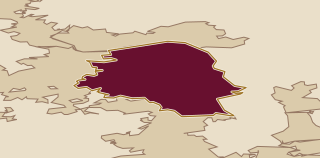
Bastianshauser Hof lies about three kilometres west of Bechtheim, in Bechtheim-West in southern Rheinhessen. The estate is not confined to one named slope: its documented holdings extend through Bechtheim, Westhofen, Gundersheim and Gundheim. That spread matters when moving from an estate name to a bottle, because the wine can draw on a wider set of Rheinhessen vineyard places than the address alone suggests.
Named sites include Geyersberg, Hasensprung, Heiligkreuz, Aulerde, Höllenbrand and Sonnenberg. Riesling provides the clearest thread through those places in the documented range, while Silvaner and the Pinot varieties show that the estate’s work is not limited to one grape.
In the cellar
Vineyards and cellar
The estate is certified organic, with 2023 documented as its first certified vintage. Ecological cultivation is a farming commitment across a vineyard area described safely as about 20 hectares, since the available figures differ slightly. It sits alongside a broad grape mix: Riesling is central, but Silvaner, Pinot Gris, Pinot Blanc, Pinot Noir, Dornfelder and Portugieser require different picking decisions and lead to wines with different body, tannin and fruit profiles.
For the 2025 Sebastian Erbeldinger Riesling, the estate documents both vineyard sourcing and fermentation. That bottle therefore offers more than a generic estate claim: fruit selection and cellar handling are part of its stated construction. The material does not support applying one fermentation method or one oak treatment across every wine in the range.
Wines to know
The range in view
The estate divides its offer into two collections, one of them the Sebastian Erbeldinger line. Riesling is the clearest place to begin within that structure: the named 2025 Sebastian Erbeldinger Riesling is listed separately, while the 2021 1899 Riesling is a distinct wine with its own reviewed élevage and tasting record.
Beyond Riesling, the white range brings Silvaner, Pinot Gris and Pinot Blanc into play, moving attention from acid-driven citrus fruit toward different degrees of weight and texture. Pinot Noir, Dornfelder and Portugieser form the red side, where tannin, cherry-like fruit and savoury notes can matter more than the freshness expected from Riesling. Exact cuvée details should remain bottle-specific rather than being inferred from the grape list.
A useful way in
A bottle to begin with
Start with the 2025 Sebastian Erbeldinger Riesling. It is the named current Riesling for which the estate provides vineyard, fermentation and sensory material, and it keeps the first encounter focused on the grape at the centre of the range. Expect citrus and orchard fruit, a light-to-medium body, lively acidity and a dry finish. It is a clearer opening than the separately positioned 1899 Riesling because it joins the estate name, the current vintage and its documented cellar account in one bottle.