
Why it matters
The producer
The Söllner family farm has passed through several generations, and its address remains in Gösing am Wagram. Daniela Vigne joined Toni Söllner in taking over the farm in 1995, bringing a working estate rather than a newly assembled label into the Wagram DAC landscape. The result is a range with everyday varieties and vineyard-designated bottles: a Grüner Veltliner labelled Ried Fumberg names both its grape and its particular Wagram site.
The family’s history reaches back to Toni Söllner’s great-great-grandparents, who bought the property. Farming changed course in the 1990s: the estate dates organic work from 1994, and Daniela and Toni say they chose biodynamic guidelines in 1995. Those dates matter in the vines, where compost, cover crops and biodynamic preparations are part of the work behind the fruit sent to large wooden barrels; they also help explain why Fumberg is built through slow fermentation and lees ageing rather than a quick, neutral finish.
Place and vineyards
Where the wines begin
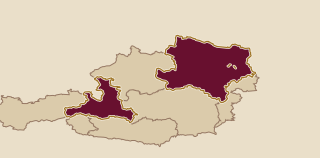
Gösing sits in Lower Austria’s Wagram area, where Soellner’s vines grow between 250 and 350 metres. Hot Pannonian days help grapes reach ripe yellow-fruit character, while cool nights and the nearby Manhartsberg forest preserve the acidity heard in Fumberg’s juicy finish. On a Wagram DAC Ried Fumberg bottle, the regional designation places the wine in Wagram and “Ried Fumberg” narrows the address to one named vineyard.
The vineyards are spread around Gösing across sites including Hengstberg, Fumberg, Berg Eisenhut, Goldberg, Vordere Taeler, Bruendlgraben and Weefel. Terraces of loess, mussel-chalk and red gravel give the farm several physical settings rather than one uniform soil, which is why a site wine such as Fumberg can be handled separately in the cellar. Fumberg itself is a two-hectare Grüner Veltliner site, worked from deeply rooted vines and selected mature berries into a concentrated, full-bodied dry white.
In the cellar
Vineyards and cellar
Between the rows, Soellner uses herbs, legumes and flowering plants, while compost is made from horse and sheep manure, grape marc and biodynamic preparations. Conventional petroleum-based pesticides and herbicides are excluded, leaving the vineyard floor actively planted rather than bare. In the cellar, white wines ferment spontaneously and remain longer on fine lees; for Fumberg, hand-picked fruit is pneumatically pressed, then ferments very slowly in large wooden barrels. The lees add mid-palate texture, while the wood supports the wine without producing an overt oak flavour.
Wines to know
The range in view
Grüner Veltliner, Roter Veltliner and Riesling form the white centre of the estate, with Muskateller and Müller-Thurgau extending the selection. Blauer Zweigelt, Merlot and Blaufränkisch provide red bottles, so the range moves beyond a single Austrian grape without losing its Wagram base. The clearest step up in documented vineyard detail is Ried Fumberg Grüner Veltliner: a dry, barrel-fermented, lees-aged white with full body, fine acidity and a firm finish. It is a different proposition from a simple varietal bottling because the label joins a named site, mature fruit selection and slower maturation.
The 2023 Ried Fumberg Grüner Veltliner opens with yellow fruit, herbs and tea, then adds melon, mint, smoke, nuts, wax and sea-buckthorn. On the palate, ripe fruit meets very fine acidity and a lightly sweet-melting texture from its development on lees. Yellow spice and delicate grip arrive toward the end, where the wine finishes firm, juicy and dry rather than soft or sugary. Its body comes from mature fruit and slow large-cask fermentation; its lift comes from the site’s retained acidity.
A useful way in
A bottle to begin with
Start with Ried Fumberg Grüner Veltliner, ideally the 2023 where available. It is Grüner Veltliner from a two-hectare vineyard, hand-picked, slowly fermented in large wooden barrels and held on its lees until maturation is complete. Expect yellow fruit, herbs, tea and melon over a full-bodied palate, with fine acidity, light waxy texture, savoury nuts and a juicy dry finish. This one bottle brings together the Wagram address, the named Fumberg site, biodynamic vineyard work and the estate’s patient cellar method.