
Why it matters
The producer
Estate bottling has been part of the Meyer family story since the 1950s, when Stefan Meyer’s grandfather began putting wine from Rhodt into bottles rather than leaving it as bulk wine. Stefan took over from his father, Willi, in 2011 after an apprenticeship at Bassermann Jordan. Stages in Burgenland, Beaujolais and Sonoma broadened his cellar experience; back in Rhodt, the result is a range that moves from straightforward Pfalz bottles to wines named for their ground and sites.
Karl Hermann Meyer began the estate with four hectares in 1954, while another directory gives a different foundation year; the firmer thread is the family’s estate bottling from the 1950s. Stefan inherited more than a cellar in 2011. His great-grandfather had been both grower and wine merchant, and his own work abroad came before taking charge at home. The resulting Syrah is not a borrowed Rhône imitation: it is a Pfalz bottle from Rhodt, made with a grape still uncommon in Germany and handled through long skin contact and barrel ageing.
Place and vineyards
Where the wines begin
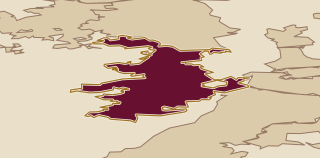
Rhodt unter Rietburg lies around 40 kilometres north of the French border, a small village of roughly 1,000 people. Its vineyards sit below the Palatinate forest and above the Rhine plain. That position matters for a red such as Klosterpfad Syrah: it is grown in the sunny Pfalz, yet the finished 2022 carries freshness alongside its full body and dark fruit rather than reading as merely heavy.
The commune’s vines run over gentle slopes of red sandstone and limestone. Bonhomie describes the estate as 16 hectares divided among 70 small plots, so a label can narrow from Pfalz to village or site rather than treating all fruit as interchangeable. Klosterpfad adds another physical detail: the current estate Syrah is grown on heavy clay, while the 2022 was described from deep clay and sand soils. Those water-holding soils help give the Syrah its dense core; acidity keeps that weight moving across the palate.
In the cellar
Vineyards and cellar
The estate moved toward organic certification, completed with the 2021 vintage, and works with biodynamic approaches in the vineyards. Manual harvesting and small parcels allow fruit to be handled separately before it reaches the cellar. Meyer also names spontaneous fermentation and long lees ageing as important parts of his work, choices that can build texture without relying only on overt oak flavour.
For the Syrah, the method is more defined. The 2022 fruit was selectively hand-harvested, macerated for a little over two weeks and spontaneously fermented on its skins, then spent a little over a year in small oak barrels. The current 2024 Klosterpfad Syrah follows the same broad shape: 14–18 days on skins and 12–14 months in small oak. Skin contact extracts colour and tannin; barrel time adds a light roasted edge to the wine’s fruit and spice.
Wines to know
The range in view
Meyer divides the range into everyday Pfalz wines and a higher line organised by soil type, village and site. That ladder is useful on the label: a site wine such as Rhodter Klosterpfad Syrah is intended to carry a more specific parcel and cellar treatment, while the 2023 Grauer Burgunder is a confirmed varietal bottling. No tasting description is supplied for that Grauer Burgunder, so its label is a grape cue rather than a promise of a particular aroma.
The Syrah is the range’s most fully documented red. The 2022 combines full body, savoury spice, dark fruit, fine-grained tannin and a mineral thread of acidity. Its 2024 successor is labelled dry and described by the estate as peppery, dense and acidic, with heavy clay beneath the vines. Across these vintages, the bottle is about Syrah’s pepper and grip meeting Rhodt’s warmer southern Pfalz setting.
A useful way in
A bottle to begin with
Start with the 2022 Syrah Rhodter Klosterpfad when it is available. It is a dry, site-named Pfalz Syrah from selected hand-picked parcels, fermented on skins and matured for more than a year in small oak barrels. Give it several hours of air and serve it around 16–18°C: the time lets its dark fruit, smoke, spice and tannin settle into a more open shape. It is the bottle where Rhodt’s clay-and-sand ground, the grape’s savoury side and Meyer’s hands-on cellar work meet most clearly.