
Why it matters
The producer
Tegernseerhof joins a very old property to a current family operation. The estate traces its history to a Wachau land grant from Emperor Henry II to the Benedictine monastery of Tegernsee; the Tegernseerhof itself was built in 1176 and took its name from its owner. Today Martin Mittelbach runs the winery, so the name on a bottle links a medieval building in Unterloiben with a fifth-generation grower working Wachau fruit.
The family’s current wines are shaped by a clear stylistic turn. After taking over young, Mittelbach moved the estate away from his father’s sweeter style towards notably dry, straight wines. For Grüner Veltliner, that decision places fruit, body and finish ahead of residual sweetness.
Place and vineyards
Where the wines begin
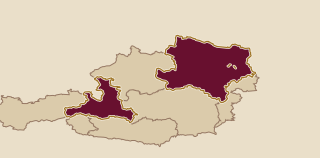
Unterloiben lies near Dürnstein in the Wachau, the Danube valley wine area within Lower Austria. Tegernseerhof’s address matters because Wachau is not a broad regional label detached from the vines: its vineyards climb terraces above the valley, where exposure and slope are part of daily growing conditions.
The estate belongs to Vinea Wachau, the growers’ association founded in 1983. Its membership places Tegernseerhof within a regional framework of production commitments, while the wine still begins with the estate’s own eastern-Wachau holdings. Bergdistel carries the Wachau origin on a Grüner Veltliner bottle, connecting grape and place directly on the label.
In the cellar
Vineyards and cellar
Fruit is sorted at harvest, and botrytis-affected grapes are excluded. That selection narrows what reaches the cellar, keeping compromised fruit out before fermentation and supporting a cleaner fruit profile in the finished wine.
The wines are raised in steel rather than oak. Steel does not contribute barrel spice, toast or vanilla, so Grüner Veltliner can show citrus, herbs, body and acidity without an oak layer over them. This is a practical cellar choice that suits Mittelbach’s move towards dry, direct wines.
Wines to know
The range in view
The 2022 vintage is listed at 13. 5% alcohol, placing it in a fuller-bodied Wachau frame rather than the lightest possible expression of the grape.
Tegernseerhof also works under Vinea Wachau’s regional production commitments, but the supplied evidence does not verify a complete current bottle list or assign individual Tegernseerhof wines to the association’s categories. Bergdistel is therefore the named wine to follow, while the estate-wide pattern is dry wine, carefully selected fruit and steel élevage rather than oak-led texture.
A useful way in
A bottle to begin with
Start with Tegernseerhof Bergdistel Grüner Veltliner 2022. It is a confirmed Wachau Grüner Veltliner at 13.5% alcohol, made by the estate in Unterloiben and connected to Mittelbach’s dry, straight direction. The bottle puts the producer’s central grape, region and cellar approach in one place.