
Why it matters
The producer
The estate is based at Zieregg 13, 8461 Ehrenhausen, where Manfred Tement took over his father’s wine-growing business in 1976. Armin joined in 2005 and took formal responsibility in 2008; Stefan joined in 2010, and Monika is part of the present family team. That family continuity carries into a range where Sauvignon Blanc keeps a herbal, high-acid line while Morillon receives more time in oak.
Tement began from a small family holding rather than a ready-made large estate. After his father died unexpectedly, Manfred inherited roughly three hectares and took over in 1976. The later family handover brought Armin and Stefan into the work, while the 2004 creation of Domaine Ciringa carried the project over the border from Zieregg. The estate’s long organic transition then reached Demeter and Respekt biodynamic certification with the 2022 vintage, tying vineyard work to fruit grown across this wider, connected set of slopes.
Place and vineyards
Where the wines begin
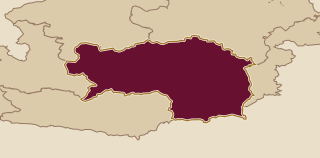
Tement’s vineyards lie in Steiermark and across the nearby Slovenian border, with prized Austrian slopes facing from southeast to southwest. These elevated exposures help retain freshness while fruit ripens, which is why the Sauvignon Blancs can show lemon, gooseberry and nettle without losing their dry, energetic palate. On the Slovenian side, Domaine Ciringa directly adjoins Zieregg, extending the family’s work across one hill rather than into a separate wine landscape.
Soil names are useful here because they appear in the wines. Kalk & Kreide refers to limestone and clay associated with Tement’s South Styrian vineyards; its Sauvignon Blanc is blended from 50 sites, bringing those materials into a regional wine with direct fruit and acidity. Muschelkalk denotes limestone in the Morillon range, where the 2023 wine’s citrus, stone fruit and savoury mineral character sit within a firmer, dry shape. Ciringa lies at 340 to 480 metres on coralline limestone, joining altitude and rock in its Slovenian Sauvignon Blanc sites.
In the cellar
Vineyards and cellar
Biodynamic certification from the 2022 vintage sets the farming frame, while the cellar separates the wines by intended shape. Kalk & Kreide Sauvignon Blanc spends six months in stainless steel, keeping pear, blackcurrant leaf and citrus close to the surface and the acidity clean-cut. Morillon Muschelkalk spends longer maturing with oak, so Chardonnay from limestone develops more body, savoury detail and a broader texture. The cellar is not used to blur the difference between grapes: Sauvignon Blanc stays aromatic and herbal; Morillon carries more oak and weight.
Wines to know
The range in view
Kalk & Kreide Sauvignon Blanc is the regional starting level: a 50-site blend with gooseberry, pear, nettle, lemon and mineral notes, shaped as a very fresh dry wine. Morillon Muschelkalk changes grape and method together, using Chardonnay from limestone and longer oak maturation for citrus and stone fruit over a savoury, dry palate. Above these regional bottles, Ried Sulz Morillon and wines from Ried Zieregg name individual vineyards. The 2021 Ried Sulz has documented ageing potential, while Ried Zieregg IZ Reserve is a more mature reserve-level expression from the Zieregg hill. Domaine Ciringa adds Slovenian Sauvignon Blancs including Fosilni Breg, Pruh and Reserve bottlings.
A useful way in
A bottle to begin with
Start with Kalk & Kreide Sauvignon Blanc. It gathers fruit from 50 South Styrian sites and names the limestone-and-clay ground in its title, while six months in stainless steel keep the wine dry, aromatic and driven by acidity. Expect gooseberry, blackcurrant leaf, pear, nettle and lemon rather than oak or creamy texture. It is the clearest first view of Tement’s Sauvignon Blanc: a regional blend whose fresh fruit and mineral notes show how the estate handles its broadest vineyard base.