
Why it matters
The producer
Tobias Becker calls himself a winegrower from Mommenheim, and the estate remains rooted in a family tradition he intended to continue from childhood. Its 20 hectares allow work across several named sites rather than one single hillside; the result is a range that can move from white grapes grown in older parcels to dry red Spätburgunder.
Becker’s decision to continue the family’s work became a practical estate project: in 2019, the winery moved its operations and used the move to modernize and enlarge the facilities. The change did not narrow the vineyard picture. Instead, the estate retained its spread of sites and grapes, with the Burgundy family at the centre and Rheinhessen varieties, Grüner Veltliner and Syrah around it.
Place and vineyards
Where the wines begin
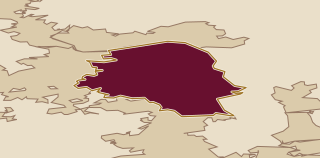
Mommenheim lies in Rheinhessen, and Becker’s vineyards extend beyond the village to sites in Selzen and Zornheim. Kloppenberg, Silbergrube and Osterberg are the highlighted Mommenheim names, while Selzener Gottesgarten, Bergpfad, Kranzberg and Zornheimer Mönchbäumchen widen the estate’s vineyard frame. Different slopes and soils bring different ripening conditions, so the portfolio has room for both the Pinot focus and a broader cast of regional grapes.
Mommenheimer Kloppenberg combines marl with loamy clay and is associated by the estate with Spätburgunder. Those water-holding soils can support fruit through dry periods, helping Pinot Noir arrive with ripeness while retaining the acidity needed for a dry red’s shape.
In the cellar
Vineyards and cellar
The estate says it harvests only fully ripe, healthy grapes and deliberately controls yields. Ripeness supplies fruit weight; lower crop levels concentrate what reaches the press or fermenter. In a Spätburgunder, that approach can support red-berry fruit and a fuller middle of palate without needing to turn the wine into a heavy red.
Becker describes its farming in terms of using no more resources than nature can replenish. Solar panels, combined heat and power, pellet heating, an air-source heat pump and battery storage are part of the estate’s energy system. These are operational choices rather than flavour additives, but they sit beside a vineyard programme built around healthy grapes and controlled yields.
Wines to know
The range in view
The portfolio is arranged in three named series: The Circle, Triangle and Square. Their names are documented, but they should not be read as a stated ladder of quality or price. Across them, the grape range runs from Riesling and Pinot Blanc or Pinot Gris to Scheurebe and Grüner Veltliner, then into Spätburgunder, Syrah, Merlot and Cabernet.
The current 2024 Spätburgunder Trocken is the clearest red-wine reference. Its reported cherry, violet and pepper aromas lead toward strawberry, raspberry and wild-raspberry fruit, with fresh acidity and silky tannin. That combination places the wine in a dry, medium-bodied Pinot Noir register: fruit at the front, gentle grip through the palate, and spice rather than dense black-fruit weight.
A useful way in
A bottle to begin with
Choose Becker Spätburgunder Trocken 2022, the Swedish-listed bottle with Systembolaget product number 5241001. It is confirmed as 100% Spätburgunder, Germany’s name for Pinot Noir, which puts the estate’s Burgundy focus in one straightforward dry red. The current 2024 release points to the style around it: cherry, violet, pepper, red berries, fresh acidity and silky tannin. Begin with the 2022 for the grape and the producer’s central direction; use the 2024 tasting description as a guide to the present release, not as a claim about the older vintage.