
Why it matters
The producer
The Paschinger family describes more than 400 years at Urbanihof. Sonja and Franz now work from Fels am Wagram, with an organic certification completed in 2016. The long family run is visible less as a historical claim than as a working estate with dense vine planting, restricted yields and compost made on site from horse manure and grape pomace; those choices direct attention towards vine growth and fruit rather than a large-volume range.
Urbanihof’s recent story has a dated turn: organic certification was completed in 2016. In the vineyards, dense planting and deliberately restricted yields sit alongside compost and green manure, linking the certification to repeated seasonal work rather than a label alone. Sonja and Franz Paschinger oversee this programme as the family’s eleventh generation; its most tangible result for the drinker is a range where a named Grüner Veltliner can be followed from Ried Dorner through fermentation and three months on fine lees.
Place and vineyards
Where the wines begin
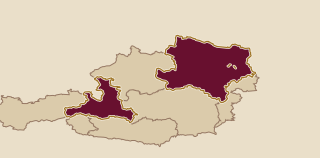
Urbanihof is based in Fels am Wagram and works vineyards reported across Brunnthal, Diebstein, Dorner, Leiten, Mitterweg, Steinagrund and Wurra. Wein.plus lists 24.5 hectares of vineyards across those sites. Dorner appears on two 2019 labels: Grüner Veltliner Ried Dorner 1598 and Ried Dorner Roter Veltliner, so the vineyard name connects bottles made from different white grapes rather than naming one fixed wine style.
Urbanihof handles the ground with composting, green manuring and no mechanical soil work between October and May, a period intended to encourage humus formation. Compost from horse manure and grape pomace returns winery and farm material to the vineyard, while the winter pause leaves the soil undisturbed during those months.
In the cellar
Vineyards and cellar
Dense planting puts vines close together, while restricted yields limit the crop each vine carries. Urbanihof pairs this with estate-made compost, green manuring and a winter period without mechanical soil work, all directed towards humus formation. For the 2019 Grüner Veltliner Ried Dorner 1598, fermentation and three months on fine lees add a cellar layer to that vineyard work: lees contact is associated here with a fuller texture alongside the wine’s mineral character and acidity.
The 2019 Ried Dorner Roter Veltliner takes a different cellar route. It is recorded as off-dry and matured in barrique, so sweetness and barrel maturation distinguish it from the dry, acidity-led Grüner Veltliner 1598.
Wines to know
The range in view
Grüner Veltliner leads the reported plantings at 40%, with Riesling, Welschriesling, Pinot Blanc and Chardonnay extending the white-wine roster. Zweigelt accounts for 20%, while Blauburger and Blaufränkisch add further red varieties. This is a broad grape base, but two bottles show separate white-wine directions rather than one house formula.
The 2019 Grüner Veltliner Ried Dorner 1598 is a vineyard-named wine fermented and kept for three months on fine lees. Its range role is dry white wine with acidity, mineral character and texture. The 2019 Ried Dorner Roter Veltliner is also tied to Dorner, but its off-dry palate and barrique maturation bring sweetness and oak into the picture. The reported red varieties broaden the estate beyond these whites,
A useful way in
A bottle to begin with
Start with the 2019 Grüner Veltliner Ried Dorner 1598 when it is available. It ties together the estate’s leading grape, a named Dorner vineyard, fermentation and three months on fine lees. Expect fruit, herbs and floral notes first, followed by marked acidity, mineral character and a textured palate. It brings vineyard name, cellar treatment and flavour into one glass.