
Why it matters
The producer
Jana Niederberger owns the estate; Stephan Attmann is managing director and Kurt Rathgeber is cellarmaster. Their work is concentrated on Riesling, with the grape carrying most of the vineyard area and the classified vineyard names carrying much of the range. A label such as Kirchenstück Riesling GG therefore joins a grape, a Forst site and a high-level classified wine rather than simply naming a style.
The estate’s name records a change made in 1907, when Leopold von Winning took it over and gave it his own name. He also redirected the property toward quality-focused winemaking, shifting the estate’s course well before its present Riesling GG range existed. The result is a house whose history is attached to a person and a name, while its present bottles locate that inherited name in vineyards such as Kieselberg, Pechstein and Kirchenstück.
Place and vineyards
Where the wines begin
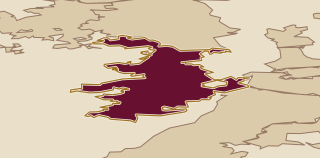
Deidesheim is the estate’s home, but its important Riesling holdings stretch across two neighbouring Pfalz villages. In Deidesheim, Kalkofen, Kieselberg, Langenmorgen and Grainhübel supply named sites; in Forst, the holdings include Kirchenstück, Jesuitengarten, Pechstein and Ungeheuer. That spread turns Riesling from one house wine into a set of site bottles, with each vineyard name giving the range a distinct point of reference.
Weathered red sandstone, tertiary limestone and basalt occur within von Winning’s vineyard geology. These are not interchangeable backdrops: the estate bottles classified Rieslings from separately named sites in Deidesheim and Forst, allowing a Pechstein or Kirchenstück label to point to a particular vineyard source rather than a blended regional address. The geological mix gives the estate physical variation to work with while Riesling remains the common grape.
In the cellar
Vineyards and cellar
Since 2008, von Winning has used spontaneous fermentation in wooden barrels and, where possible, moves wine by gravity rather than pumps. Those choices put wood and handling into the frame without making every bottle taste alike: the site Rieslings remain organised by vineyard name, while Sauvignon Blanc 500 is explicitly selected from 500-litre barrels. In that wine, oak, fruit, texture and acidity are all part of the stated profile, showing that barrel work is intended to sit alongside freshness rather than cover it.
Wines to know
The range in view
Riesling is the range’s backbone. The GGs draw attention to individual classified sites, including Pechstein and Kirchenstück in Forst: the former is presented with aromatic and mineral character, while Kirchenstück brings aroma, palate structure, acidity and salinity into view. These are wines for comparing how two named vineyards carry the same grape through different structural shapes.
Sauvignon Blanc forms a separate ladder: II, I, Imperiale, 500, 500 Reserve and OTC. Sauvignon Blanc 500 sits within the more selected end of that sequence, chosen from 500-litre barrels. Its fruit, oak, acidity and texture make it a different proposition from the Riesling GGs: less about a classified Riesling site and more about how one variety responds to barrel selection.
A useful way in
A bottle to begin with
Start with the 2023 Kirchenstück Riesling GG. It is a Riesling from one of von Winning’s Forst classified sites, and its profile brings together aroma, palate structure, acidity, salinity and the capacity to develop with age. That combination makes it a direct way into the estate’s main subject: Riesling shaped through a named vineyard, then carried through the cellar without losing its dry, firm line and long finish.