
Why it matters
The producer
Weingut Waldschütz is a family estate in Straß-Elsarn, at the beginning of Kamptal. The winery dates its tradition to 1871 and says the family has cultivated Kamptal vines for several generations. Its bottles begin with four grapes—Grüner Veltliner, Riesling, Weissburgunder and Gelber Muskateller—grown on soils the estate describes as mineral, then move through a cellar equipped with modern technology.
The Waldschütz family frames its winegrowing history as a line running back to 1871, but the working method is not frozen in time. Organic vineyard work, hand harvesting and close attention in the cellar sit beside modern equipment. The result is a range that can stay straightforward in its Kamptal DAC wines while leaving room for a bottle such as Steinvision, shaped by an unusually heavy stone vessel and three separate harvests.
Place and vineyards
Where the wines begin
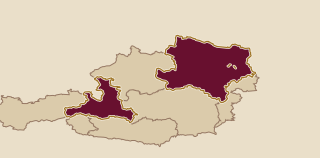
Straß-Elsarn places Waldschütz at Kamptal’s eastern beginning, where Grüner Veltliner and Riesling appear under the Kamptal DAC name on current releases. The appellation on the label ties the grape to Kamptal; the estate’s Grüner Veltliner and Riesling therefore provide the most direct view of how Waldschütz works with its home region.
The estate names mineral soils rather than a more detailed geological breakdown. That physical clue returns in the reported profile of the 2024 Riesling Strass Venesse: its palate is taut and mineral, with six months in stainless steel keeping the fruit and dry structure at the front of the wine.
In the cellar
Vineyards and cellar
Hand harvesting gives the estate control over when grapes are picked and brought into the cellar, while its stated organic approach keeps vineyard work close to nature. In the cellar, the documented approach is careful handling supported by modern technology; the clearest concrete departure is Steinvision, which spent 36 months in a 2,000-kilogram natural-stone vessel. That long stay makes vessel choice part of the wine’s structure rather than a passing production detail.
Wines to know
The range in view
The range begins with Grüner Veltliner, Riesling, Weissburgunder and Gelber Muskateller, then gives Grüner and Riesling a Kamptal DAC frame. The 2024 Grüner Veltliner Kamptal DAC is the current estate release, while the 2024 Riesling Strass Venesse Kamptal DAC offers a more defined recorded profile: Riesling, six months in stainless steel and 6 g/l residual sugar.
The 2021 Kamptal Grüner Veltliner supplies the clearest aromatic picture, with lemon zest, ginger and exotic spice. Steinvision sits elsewhere in the range: a limited cuvée joining 2019, 2020 and 2021, with its long maturation in stone giving it a distinctly cellar-led role beside the varietal wines.