
Why it matters
The producer
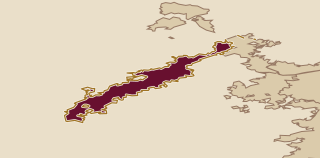
Bernhard Werner works with a small, Riesling-led holding spread across nearly 20 kilometres of the Mosel. That distance brings Schweicher Annaberg, Trittenheimer Apotheke and Leiwener Laurentiuslay into one estate rather than one uniform site, so the range moves from dry and feinherb Riesling to late-harvest wines with more sweetness.
The Werner family’s earliest cited link to farming and winegrowing is in Trittenheim in 1650, when a Werner farmer-winegrower erected a plague cross. The record is not a claim of uninterrupted operation under today’s estate name, but it places the family’s documented wine history in the same Mosel landscape where Trittenheimer fruit remains part of the present vineyard portfolio.
Place and vineyards
Where the wines begin
Leiwen sits in the Central Mosel, while Werner’s plots reach beyond the village over a long stretch of vineyard land. The producer says 60% of its six hectares lie on steep slopes; working those sites limits easy mechanisation and concentrates attention on harvesting, feeding dry Riesling with ripe fruit while preserving the acidity that keeps the palate moving.
Schweicher Annaberg combines older Permian rock with red slate and greywacke. Its historical maps recorded it as first-class terroir in 1868, but the useful detail in the glass is physical: hard, varied ground and a steep vineyard ask roots to work through broken rock rather than deep soil.
In the cellar
Vineyards and cellar
Werner describes close-to-nature vineyard work, low yields and rigorous selection at harvest. On steep Riesling sites, lower yields and selective picking concentrate the available fruit; the consequence is a wine built with extract and weight rather than fruit diluted by large crops.
Grapes and must are handled gently, and fermentation happens predominantly in traditional Fuder casks with natural yeasts. A Fuder is a large old German oak barrel: its scale and age make it a vessel for fermentation rather than a loud source of new-oak flavour. Across the estate, that approach leaves room for citrus, peel and slate-derived savoury notes to carry the finish.
Wines to know
The range in view
Around 80% of Werner’s wines are dry or feinherb. Dry Riesling provides the firmest line of acidity and citrus fruit; feinherb wines retain some sweetness, softening acidity without turning the range into dessert wine. Pinot Noir accounts for 10% of the plantings, while St. Laurent and Rivaner together make up the remaining 5%, giving the estate a small red and alternative-white margin around its Riesling core.
The sweeter end is formed by fruity Riesling Spätlese, selected Auslese and Beerenauslese. These late-harvest categories bring greater ripeness and sweetness, so body and fruit weight rise while Riesling acidity prevents the palate from becoming blunt. Vom Steilen Hang Riesling Trocken sits at the dry end: a 100% Riesling drawn from the estate’s best steep slopes in the succeeding 2024 release.
A useful way in
A bottle to begin with
Start with Werner Vom Steilen Hang Riesling Trocken. It is a dry, 100% Riesling and a direct expression of the estate’s steep-slope work: the 2023 wine combines fuller body and extract with mandarin, grapefruit, citrus peel and bitter grip. Its dry finish makes the contrast clear between fruit weight and acidity, while the estate’s Fuder-and-natural-yeast cellar practice gives useful context without claiming a bottle-specific regime for this vintage.