
Why it matters
The producer
Five generations of Willems women have managed the family business, and Carolin Hofmann, née Willems, was making her own wine by 2001. Her early direction was dry and feinherb Riesling: two expressions of the same grape, with the first leaving the palate dry and the second allowing sweetness to round Riesling’s acidity. That choice still gives the estate a clear shape, from the family name on the label to the way its Saar fruit is framed.
The property was still a mixed farm until 1971, rather than a specialist wine estate from the outset. Carolin’s move into her own wines by 2001 narrowed the focus toward Riesling, especially dry and feinherb bottlings. The result is not a collection built around an unsupported flagship claim, but a small Saar estate using one grape in two useful registers: dry wines where acidity stays exposed, and feinherb wines where a measured sweetness changes the texture and flow.
Place and vineyards
Where the wines begin
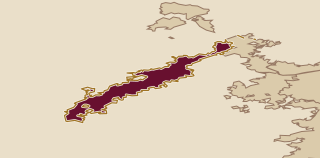
Konz-Oberemmel lies near the meeting point of the Saar and Mosel. The estate’s vineyards curve toward the south and sit out of direct wind, a setting that helps Riesling and Pinot vines ripen in the cool Saar Valley. In a region where acidity can be firm, sheltered exposure matters: it supports fruit maturity without erasing the citrus-like freshness that makes a light Kabinett wine feel lively rather than dilute.
Devonian slate mixed with fine earth forms the documented ground beneath the vines. Slate is a stony, heat-holding material, while the fine earth adds another physical component to the rooting zone; together with the south-facing curves of the vineyards, it helps the estate pursue ripe fruit in a cool place. Some vines are up to 70 years old, bringing established roots to fruit intended for wines with acidity, light body and flavour rather than sheer weight.
In the cellar
Vineyards and cellar
Vineyard work is described as natural and quality-driven, with relatively late harvesting. Waiting longer can bring more fruit maturity before picking, a practical counterweight to the Saar’s sharp acidity. In the cellar, extended barrel maturation is used to soften that edge and broaden texture, rather than simply chasing heavier wine. For the 2024 Saar Riesling Kabinett Feinherb specifically, Falstaff reports six months in steel tank, a vessel choice that keeps the bottle’s fruit and freshness ahead of overt oak flavour.
Wines to know
The range in view
The documented range is organised around dry and feinherb Riesling. Dry Riesling places citrus fruit, acidity and mineral notes in the foreground; feinherb Riesling keeps the same grape but uses off-dry sweetness to make the palate feel rounder and more easy-flowing. The named 2024 Saar Riesling Kabinett Feinherb is 100% Riesling and a Kabinett, a light German Prädikatswein style. Its low-weight frame makes the sweetness a textural element rather than a dessert-wine signal, while fresh fruit and delicate spice keep the finish active.
The 2024 Saar Riesling Kabinett Feinherb is described as fresh-fruited, lightly spicy, light-bodied and easy-flowing. Expect Riesling fruit rather than oak: a bright, fresh aromatic line, then a light palate where off-dry sweetness softens the acidity without making the wine feel heavy. Six months in steel helps preserve that clean profile. The finish should feel mobile and refreshing, with spice adding detail to the fruit rather than turning the wine savoury or broad.
A useful way in
A bottle to begin with
Start with the Willems-Willems Saar Riesling Kabinett Feinherb 2024. It brings together the estate’s documented grape, Saar setting and feinherb style in one bottle: 100% Riesling, light-bodied, off-dry and matured for six months in steel. Fresh fruit and delicate spice meet acidity on a palate designed to flow rather than weigh down. It is a practical first look at why late-picked Saar Riesling can carry a little sweetness while remaining bright, lifted and dry-feeling at the finish.