
Why it matters
The producer
Weingut Wittmann is a family-operated estate in Westhofen whose central subject is dry Riesling. Philipp Wittmann manages it with Eva, Günter and Elisabeth; he is also the national VDP’s vice-president, while Philipp and Georg Rieser are named as cellar masters. The family’s records reach back to 1663, but the wines in front of us come from a modern programme: Riesling used to show Westhofen through bottles ranging from broad regional expressions to named-site wines.
Philipp Wittmann joined the family estate in 1990, then tested stainless steel and cultured yeasts after returning to Westhofen. He moved away from those trials when the wines no longer showed the character he sought, returning to spontaneous fermentation and large wooden casks. The consequence is audible in the range: dry Riesling fruit is not covered by obvious new oak, while lees, spice, chalk and savoury notes can sit beside citrus and stone fruit.
Place and vineyards
Where the wines begin
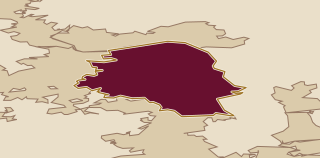
Westhofen sits in Rheinhessen, and Wittmann’s 30 hectares are reported across Aulerde, Brunnenhäuschen, Kirchspiel and Morstein. Those vineyard names matter on the label because the estate builds its dry Riesling range around differences of origin rather than around sweetness. A lighter bottle such as Estate Riesling brings citrus, herbs and lemony acidity; the Westhofen names lead toward wines with more weight, grip and site-specific detail.
Limestone is securely connected to the dry Riesling called Vom Kalkstein: its name signals calcareous material, and the 2022 wine carries chalky notes and a mineral finish. Rather than attach unsupported slope or exposure claims to Morstein, Kirchspiel, Aulerde or Brunnenhäuschen, it is more useful to follow the estate’s labels and taste how each bottling handles fruit, acidity and texture.
In the cellar
Vineyards and cellar
The estate has held biodynamic certification since 2004. Low yields and hand harvesting in several passes allow fruit to be selected as it ripens, which supports concentration without forcing excessive alcohol; the 2022 Vom Kalkstein is 12.5%. Gentle pressing protects the juice before indigenous yeasts begin fermentation, while maturation occurs almost entirely in wooden casks in the estate’s vaulted cellar.
Wood here is a vessel rather than a flavour headline. In the documented Vom Kalkstein, the cellar approach leaves room for cool citrus and stone fruit, with yeast, nuts, yellow spice and chalk adding texture. The finish has delicate grip rather than a sweet or overtly oaky close.
Wines to know
The range in view
The dry Riesling range begins with Estate Riesling, where the verified 2024 bottling has medium body, citrus, herbs, chalk and integrated lemony acidity. 100 Hills, also labelled 100 Hügel, remains dry but moves toward caramelised honey, crisp nectarine and deeper mineral notes; its medium body finishes agilely rather than heavily.
That wine combines citrus, stone fruit, floral notes, chalk, yeast and yellow spice with fine acidity and mineral grip. Above these broader labels, the estate also bottles Riesling from Aulerde, Brunnenhäuschen, Kirchspiel and Morstein, placing named Westhofen origin at the centre of the range.
A useful way in
A bottle to begin with
Choose the 2022 Vom Kalkstein Trocken Riesling. It is a dry, organic, biodynamic and vegan wine at 12.5% alcohol, made from the grape and cellar approach that define the estate. Citrus and stone fruit arrive first, then chalk, yeast, nuts and yellow spice; fine acidity keeps the palate lively, and a mineral finish carries the wine beyond the fruit. It is a useful first bottle because limestone is named on the label and the wine makes the estate’s low-yield, hand-picked Riesling and wooden-cask cellar work tangible.