
Why it matters
The producer
Katarina Bonde and Bengt Akerlind established West Wines in Dry Creek Valley, Sonoma County, where the family works with estate-grown grapes. The producer’s stated French-method approach matters most in the way it positions California fruit: Cabernet Sauvignon is not simply a ripe red from a warm state, but fruit intended for a structured, food-ready wine with tannin and shape.
West Wines began as a family winery in 1998, founded by Bonde and Akerlind in Healdsburg’s Dry Creek Valley. Bonde later completed a UC Davis Winemaker Certificate in 2012 after practical winery work and formal study. That combination sits alongside the estate’s French-influenced approach: California-grown grapes remain at the centre, while the intended result is a wine shaped by vineyard source, tannin and cellar decisions rather than by a generic regional style.
Place and vineyards
Where the wines begin
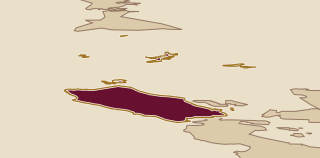
Dry Creek Valley is the address on West Wines’ vineyard work, with Healdsburg as the local base and Sonoma County as the wider region. West Crest Estate, which supplies the estate Cabernet Sauvignon, sits on ridge and rolling-hill ground above the valley floor. Its west- and south-facing position puts the Cabernet on an exposed elevated site, making the vineyard itself part of the bottle’s story rather than a label detail.
The documented site facts are topographical: West Crest lies on west- and south-facing ridges and rolling hills, 300 feet above the valley floor on the detailed vineyard description. That elevated, sloping terrain distinguishes the Cabernet site from valley-floor ground and helps explain why West Wines can name West Crest Estate on a Cabernet Sauvignon rather than treating all estate fruit as interchangeable.
In the cellar
Vineyards and cellar
The vineyards use cover crops for plant nutrition and as habitat for beneficial insects that help with pest control. This links the rows between the vines to the fruit that reaches the cellar: vineyard management is treated as part of growing estate grapes, not as an ornament around the winery. West Wines also works to reduce energy and water use, with solar power included in the estate’s practices.
In the cellar, the documented guiding idea is traditional French methods applied to estate-grown grapes. The specific effect is clearest in the Crest Cuvée: when Cabernet Sauvignon from a small 2017 harvest was intensely tannic, West Wines brought in Merlot for a softer, more aromatic component. The blend was a response to the wine in hand, using grape character to alter texture and perfume.
Wines to know
The range in view
The confirmed estate red is West Crest Estate Cabernet Sauvignon, tied directly to the elevated West Crest site. Cabernet Sauvignon brings the structural side of the documented range: tannin, body and grip are central to how the grape appears in the 2017 Crest Cuvée, where the harvest was notably tannic.
Crest Cuvée adds Merlot to Cabernet Sauvignon. Merlot’s role was explicitly to soften the small-harvest Cabernet and add more aromatic character, so this is not merely a two-grape label: it is a blend built around a tactile problem in the cellar. Chardonnay is also part of West Wines’ recorded history; Julia Iantosca, the winery’s first winemaker, made Chardonnay and Cabernet Sauvignon through 2008. Seafoam is another named cuvée, its name drawn from the feel of its fine bubbles rather than from an unsupported technical claim about its production.
A useful way in
A bottle to begin with
It combines Cabernet Sauvignon with Merlot after a small harvest produced intensely tannic Cabernet: Merlot was added for a softer palate and more aromatic character. Pour it with a meal that can meet its tannin and body, then notice how the blend moves from Cabernet’s grip toward a more rounded texture. It puts a specific vintage decision in the glass.