
Why it matters
The producer
Fouché was born in Cape Town and raised in the Swartland, the dry Western Cape region supplying most of Wolf & Woman’s fruit. Her B. Agric training at Elsenburg and harvest work in Australia and California precede wines made from hand-picked grower fruit, with native fermentations and only a small sulfur addition. The result is a range whose grape varieties remain easy to recognise while lees, whole clusters and site selection add body, perfume and grip.
Wolf & Woman began with Fouché’s Swartland connection and an interest in old vines, not with an inherited estate. The 2018 maiden release contained Chenin Blanc and Pinotage, two grapes that still explain the project’s direction: one white capable of acidity and lees-derived breadth, one red handled with enough whole clusters to retain floral and herbal lift. Tim Atkin MW named the 2018 Chenin Blanc his White Wine Discovery of the Year in his 2019 South Africa Special Report, an early notice for a first release built from grower vineyards.
Place and vineyards
Where the wines begin
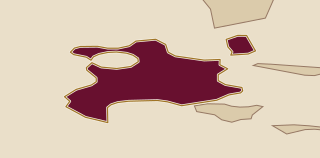
The Swartland is Wolf & Woman’s central address, with additional fruit from Voor-Paardeberg and Piekenierskloof. Within that wider area, the wines name more exact origins: 2024 Pinotage comes equally from Paardeberg and northwest Malmesbury, while 2024 Syrah is 90% Malmesbury and 10% Riebeekberg. Those separate parcels keep the labels tied to particular grapes and places rather than treating the Western Cape as one uniform source.
The 2020 Chenin Blanc shows how closely this project can follow individual vineyards. Two Paardeberg sites, planted in 1971 and 1980, grow on granite; a third vineyard, planted in 1981 north of Malmesbury, sits on iron-rich red soil. These old Chenin vines supplied a wine whose later versions retain a dense, bright shape: fruit from several ground types is gathered into one dry white rather than separated into named single-vineyard bottlings.
In the cellar
Vineyards and cellar
The grower vineyards are described as sustainably farmed, and the fruit is harvested by hand, allowing individual lots to reach the cellar intact. Fermentations receive no additions apart from a small amount of sulfur, and no components are removed from the wines. For whites, substantial lees contact adds breadth and a textured finish: the 2024 Chenin spent ten months on gross lees in neutral, seasoned French oak. For reds, whole clusters bring stems into the ferment; the 2024 Syrah used 80% whole clusters, while the 2024 Pinotage used 15%, helping pepper, herbs and floral notes sit alongside ripe berry fruit and tannin.
Wines to know
The range in view
Chenin Blanc is the clearest white thread: the 2024 is entirely bush-vine Chenin, whole-bunch pressed and fermented in seasoned 300- and 500-litre French oak before ageing in neutral barrels. Its lemon and nectarine fruit meets honey, spice and hay, with acidity holding the dense palate in line. Pinotage is a separate red register—100% Pinotage with cherry, currant, herbs and spice, concentrated but fresh and sleek. Syrah, also 100%, is sourced largely from Malmesbury and shows berries, flowers and pepper over juicy fruit and silky tannins. Grenache Blanc and Grenache Rosé complete the documented range, extending it beyond Chenin and the two darker reds without confusing their distinct roles.
A useful way in
A bottle to begin with
Choose the 2024 Chenin Blanc first. It is 100% bush-vine Chenin from a producer whose work begins with old Swartland vines, then whole-bunch pressing and ten months on gross lees in neutral French oak. Lemon, nectarine, honey, spice and hay make the aroma concrete; the dense palate, bright acidity and textured finish show what the cellar is doing with the fruit. It introduces the project’s white-wine method without asking the bottle to stand in for the entire range.