
Why it matters
The producer
Originally from Picardy in northern France, Xavier Vignon spent ten years travelling through France’s wine regions before settling in the Rhône. Seven of those years involved consecutive northern- and southern-hemisphere harvests, and at 27 he chose consulting oenology as his work. That long circuit now feeds a Rhône range built by selecting fruit from old vines and blending it into appellation wines rather than treating one parcel as the whole story.
Vignon arrived in the Rhône after learning through travel and harvest work, then built a practice that combines consulting, vineyard selection and bottles released under Xavier Vignon and Xavier Vins. The decision is visible in the range: a regional Côtes du Rhône can be fruit-led and firmly framed, while a Châteauneuf-du-Pape can carry black-cherry, blackberry and garrigue notes. Instead of applying one formula to every appellation, he uses the requirements and raw material of each wine as the starting point.
Place and vineyards
Where the wines begin
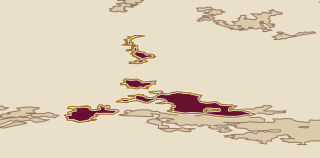
Vignon explored the Dentelles de Montmirail between Lafare and Suzette before settling in the area, while the winery is listed at 1901 route de Sorgues in Châteauneuf-du-Pape. The range therefore moves through southern Rhône names with distinct legal and geographic frames: Côtes du Rhône provides the broad regional setting, Vacqueyras narrows the address, and Châteauneuf-du-Pape carries its own appellation rules and blend tradition. Those names signal different wine shapes rather than interchangeable labels.
The documented site approach is selection across different terroir types, then blending within each appellation wine. In practice, that means a bottle such as Châteauneuf-du-Pape is assembled from complementary components instead of being presented as a single-soil cuvée: fruit, acidity, tannin and weight can be balanced across the final blend. The old, low-yielding vines matter here because fewer grapes per vine concentrate the fruit and structural material brought into that blend.
In the cellar
Vineyards and cellar
The vineyard material comes from old, low-yielding vines, and Vignon favours gentle extraction during vinification. Gentle extraction limits how aggressively colour, tannin and bitter phenolics are pulled from skins, so a red Rhône blend can retain fruit and savoury detail without relying on sheer grip. Restricting oenological inputs to a strict minimum keeps the cellar’s role focused on handling the fruit rather than masking it.
Ageing is also part of the house vocabulary. For some wines, Vignon uses Vinarium, a system in which small filled barrels are immersed in wine. The producer describes the environment as fully humid and protected from sulphur, oxygen and outside influence; the intended consequence is maturation without the normal oxidative contact around a barrel. It is a specific tool, not a description of every bottle in the range.
Wines to know
The range in view
Côtes du Rhône Vieilles Vignes 2023 is the wide-angle bottle: a fruit-led red with oak, tannin and a firm structural frame. It shows how a regional appellation wine can deliver ripe Rhône fruit while still carrying enough grip for food. Organic Vacqueyras 2022 moves into a more defined appellation, with its own documented terroir, vinification and ageing details rather than a generic step up in status.
Châteauneuf-du-Pape 2022 is the more complex southern Rhône blend in the documented range, with black cherry, blackberry and garrigue at its aromatic core. Arcane La Papesse 2016 takes a different route again: part of its maturation used Vinarium, making cellar method part of the wine’s character. Together, these bottles show a range arranged by appellation and treatment, from straightforward regional fruit to a long-matured experimental cuvée.
A useful way in
A bottle to begin with
Start with Xavier Vignon Châteauneuf-du-Pape 2022. It connects the producer’s old-vine selection and cross-terroir blending with a recognisable southern Rhône glass: black cherry, blackberry and garrigue, fuller body, savoury weight and a long dry finish. It is more direct than the technically unusual La Papesse, yet it shows why Vignon works across complementary terroirs within an appellation rather than making every wine a single-site statement.