
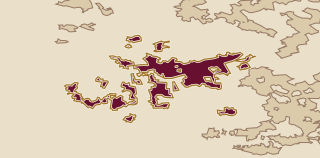
Balatonboglár lies mainly along Lake Balaton's southern shore. Its moderately warm continental climate brings 1,950 to 2,050 sunshine hours, average annual temperatures of 10 to 10.5°C, and 600 to 800 mm of precipitation. The wines combine fruitiness, concentration and drinkability, with ageable red styles among them.
Elsewhere in Lake Balaton
Continue through the region
- Badacsony1 producerBadacsony's basalt slopes give Olaszrizling and Kéknyelű texture, smoke and freshness. Retaining-wall terraces remain part of the vineyard landscape.
- BalatonNo producers listed yetBalaton's six wine districts share Olaszrizling but not one style. Northern and southern vineyard conditions differ, and the area includes white wines as well as ageable red styles.
- Balaton-felvidékNo producers listed yetOn Lake Balaton's northern shore, Balaton-felvidék shares climate and soil influences with Badacsony and Balatonfüred-Csopak.
- Balatonfüred-CsopakNo producers listed yetBalatonfüred-Csopak makes Olaszrizling and Kékfrankos at village and single-vineyard level. It is especially associated with Olaszrizling, while Tihany has a separate specification.
- Csopak1 producerCsopak works with Olaszrizling and Kékfrankos at village and single-vineyard level.
- KáliNo producers listed yetKáli's hills are largely made of volcanic debris rock, with little lava rock.
- Nagy-SomlóNo producers listed yetNagy-Somló belongs to the volcanic Somló identity, where vineyard orientation affects sugar, acidity and wine potential.
- SomlóiNo producers listed yetSomlói comes from a small volcanic hill, where basalt soils shape firmly acidic Furmint and Juhfark. Southern exposures combine greater ripeness with higher acidity.
- TihanyNo producers listed yetTihany is a separate entity within Balatonfüred-Csopak. Its dormant volcanic landscape has mineral-rich tuff soils and a distinct mineral expression.
- Zala1 producerZala's rain and lower sunshine favour fresher, more balanced wines. It became a wine region in 1997 after local communities requested the restoration of its classification.