
Why it matters
The producer
Champagne de Barfontarc brings 54 winegrowing families together in Baroville, with Denis Tardieux as cellar master and Olivier Martin as managing director. It is the cooperative producer identified with the Coopérative Vinicole de la Région de Baroville.
The range is divided into essential, signature, and experience tiers, alongside Champagne specialities. The essential tier includes Héritage Brut, Héritage Demi-Sec, Caractère Blanc de Noirs, Caractère Rosé, and Caractère Blanc de Blancs. Sainte Germaine belongs to the signature wines.
Place and vineyards
Where the wines begin
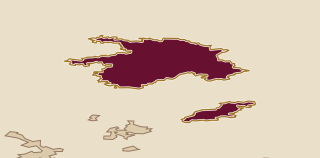
The vineyards sit around Baroville in the Côte des Bar, the southernmost vineyard sector of the Champagne appellation. The cooperative's eight villages are Arconville, Arsonval, Baroville, Dolancourt, Fontaine, Montier-en-l’Isle, Rouvres-les-Vignes, and Trannes.
This is a connected group of villages inside one cooperative, with grapes pressed and made into Champagne under the Barfontarc name. The Côte des Bar location also places the wines in the southern part of Champagne, where Pinot Noir is the dominant grape in the vineyards.
In the cellar
Vineyards and cellar
Eighty percent of the member vineyard carries Viticulture Durable en Champagne certification, with a stated target of 100% by 2030. The vineyard also carries Haute Valeur Environnementale certification. These certifications concern environmental management in the vineyard, including the way farming inputs and ecological resources are handled.
Barfontarc describes its winemaking as using as few interventions as possible. Its modern facility supports production at cooperative scale, while the cellars can hold several million bottles. The house gives prolonged ageing to all essential cuvées and to its vintage signature wines. Longer ageing allows the mousse and flavours of Champagne to integrate over time, although no exact duration is stated here.
Wines to know
The range in view
The essential tier carries the broadest set of named styles. Héritage Brut is joined by Héritage Demi-Sec, a sweeter Champagne style, while the Caractère wines include Blanc de Noirs, Rosé, and Blanc de Blancs.
Caractère Blanc de Noirs is made entirely from Pinot Noir. Sainte Germaine 2016 is a vintage wine made from 60% Pinot Noir and 40% Chardonnay. The signature tier therefore moves from a single grape Blanc de Noirs to a dated blend of both principal varieties.
A useful way in
A bottle to begin with
Héritage Brut is the first bottle to open. It belongs to the essential tier and the current release combines 82% Pinot Noir with 18% Chardonnay. The blend contains 74% wine from the 2021 harvest and 26% reserve wine from 2019 and 2020.