
Why it matters
The producer
Bertrand Brigandat farms 8.22 hectares of vines, mostly in Channes and Buxeuil, and the family domain produces about 65,000 bottles each year. About 15% of the grape harvest is sold to Laurent Perrier.
Bertrand Brigandat sums up his philosophy with a plain sentence: “His Champagnes taste like wine.” He sets that preference against large production Champagne that tastes of toast and yeast, keeping the focus on the wine itself.
Place and vineyards
Where the wines begin
Pinot Noir accounts for 83.90% of plantings in the Côte des Bars. The grape's lightness, shaped by climate, geology and careful vine husbandry, is sought by master blenders in Champagne.
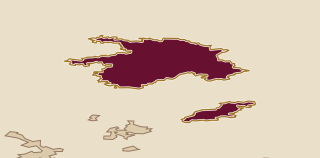
The Côte des Bars is a Kimmeridgian limestone region. Its climate and geology form part of the conditions that give local Pinot Noir a distinctive lightness, alongside the work carried out in the vineyards.
In the cellar
Vineyards and cellar
The vineyard is farmed organically, with biodynamic and homeopathic practices also incorporated into the work. Initial fermentation mostly takes place in enamel lined steel tanks, including tanks Bertrand has painted in bright, cheerful colours.
The Champagnes age sur latte for a minimum of three years and as many as seven, depending on the cuvée and the character of the base wines. Sur latte ageing keeps bottles horizontal on their lees, allowing time for the yeast contact that can build creamier texture and more developed savoury notes.
Wines to know
The range in view
The range includes Blanc de Noirs Brut, Brut Rosé and Brut Nature. Blanc de Noirs Brut is a full bodied white Champagne made from Pinot Noir. Brut Rosé brings the rosé style with fine, well integrated bubbles, while Brut Nature is made from 100% Pinot Noir.
Blanc de Noirs Brut opens with citrus, mint, cream, rocks and chalk. The palate is full bodied, clean and fresh, with a mineral impression that continues through the finish.