
Why it matters
The producer
Chiara Condello arrived at her father's winery one summer to spend a few months, and never quite left. The pivot happened in 2012, during harvest, and three years later she launched her own estate under her name, formally and legally separate from the family's Condé winery next door. Same village. Same grape. Nothing else shared.
Her project is built on 4.8 hectares of Sangiovese in the Predappio DOC, a hillside appellation in the southern Emilia-Romagna foothills east of the Apennines. The vineyards sit beside a forest at altitudes between 150 and 300 metres. She farms every row manually, bottles without filtering, and makes exactly two wines: an estate red and a riserva called Le Lucciole. In 2022, Food and Wine Italia named her Best Winemaker Under 35.
Place and vineyards
Where the wines begin
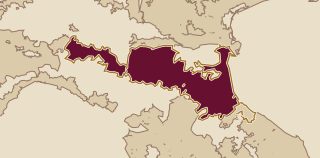
Predappio is a DOC appellation in the Forlì-Cesena province of Emilia-Romagna, tucked into the hills where the valley of the Bidente river narrows before the Apennine ridge. It is one of the cooler, higher-elevation addresses in a region more often associated with the flatlands of the Po. At 150 to 300 metres, the vineyards receive enough elevation to slow ripening and retain the acidity that Sangiovese needs to age.
The altitude matters for the label: Predappio DOC is built entirely around Sangiovese, so the appellation name on the bottle is a direct statement of grape and place together. No blending grape softens the wine, and no flatland fruit or humidity blunts the tannin. The wines carry the character of a hillside site, not a lowland one.
In the cellar
Vineyards and cellar
Chiara farms the 4.8-hectare Sangiovese estate manually, with cover crops between the rows and horse manure as fertiliser. Mechanical weed control replaces herbicides. Sulphur and copper use is kept low. The vineyards are certified organic by Suolo e Salute, the Italian standards body. Manual harvesting brings the fruit in without bruising, and the fermentation vessels are filled by gravity rather than pump.
In the cellar, fermentation runs on indigenous yeasts with minimal temperature control. Long maceration extracts colour, tannin and the aromatic compounds specific to Sangiovese on Spungone. Depending on the lot, grapes are destemmed or partially destemmed and vinified in stainless steel tanks, open-top wooden fermenters, or tonneaux. The wines age in Slavonian oak barrels, then finish in bottle. Nothing is filtered before bottling.
Wines to know
The range in view
Chiara Condello is the estate red, drawn from Sangiovese parcels across the 4.8 hectares. The destemming approach varies by lot, and the fermentation vessel varies too: steel, open-top wood and tonneaux are all used, depending on what the parcel demands. The wine ages in Slavonian oak barrels and finishes in bottle. Sour cherry, dried herbs and firm but approachable tannin are the consistent thread. The oak stays in the background.
Le Lucciole is the riserva, sourced from a single small parcel where the Spungone sandstone concentration is highest. Maceration runs 25 to 45 days, longer than the estate wine. The extra skin contact and stonier soil produce a wine with more grip, darker fruit, a deeper colour and a firmer tannin frame that needs more time in bottle to open. Where the estate wine offers early access to Predappio Sangiovese, Le Lucciole is a more demanding proposition: more concentrated, more demanding, built to age.
A useful way in
A bottle to begin with
Le Lucciole is the bottle to start with. It is the parcel-specific riserva from the portion of the estate where the Spungone rock content is highest, and it shows directly what that sandstone does to Sangiovese: more mineral pull on the finish, firmer tannin, darker fruit. Maceration runs up to 45 days, which is long for the variety and leaves a clear structural mark. The wine ages in Slavonian oak, goes into bottle unfiltered, and needs a year or two of patience after release before it opens up.