
Why it matters
The producer
Cleto Chiarli Società Agricola makes Lambrusco from estate vineyards in Modena province and has done so, in one form or another, since 1860. That founding date makes it among the oldest wine companies in Emilia-Romagna. The estate's winemaking home is the converted Villa Cialdini manor, set inside the Lambrusco Grasparossa di Castelvetro DOC, ringed by more than 100 acres of Grasparossa vines and 17 acres of Grechetto Gentile. A second zone, di Sorbara, adds a lighter, more aromatic Lambrusco type to the range.
The fourth-generation cousins Mauro and Anselmo Chiarli run the business. In 2002 they made the decision that defines the estate's current operation: they broke from volume production and built a dedicated artisanal facility at Cialdini to grow and vinify estate Lambrusco at a smaller, more controlled scale. The premium range that came out of Cialdini is what the estate is now known for.
Place and vineyards
Where the wines begin
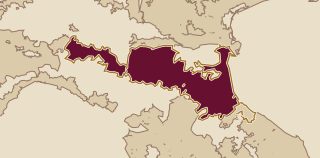
Modena province sits at the centre of Emilia-Romagna, the broad agricultural plain that runs between the Apennines and the Po valley. Lambrusco is not one grape but a family of red sparkling varieties native to this part of northern Italy, each attached to its own sub-zone with measurably different results in the glass.
Grasparossa di Castelvetro, where Cialdini sits, produces the darkest and most tannic Lambrusco: deep ruby, dense mousse, firm body. Di Sorbara, grown on different soils further north in Modena province, yields something lighter, paler, and more aromatic, with higher acidity and a finer bead. Both sub-zones are DOC appellations. The grape variety and the sub-zone together determine the colour, body, and what ends up in the bottle, which is why the Chiarli range labels both.
In the cellar
Vineyards and cellar
The estate holds vineyards across three separate zones in Modena province. The largest block surrounds Cialdini: more than 100 acres of Lambrusco Grasparossa, plus the 17-acre Grechetto Gentile planting. Two further vineyard sites hold Grasparossa and di Sorbara. The separation of grape varieties across geographically distinct parcels feeds a range grouped around appellation: Grasparossa di Castelvetro for the estate wines, di Sorbara for the Fondatore.
All vineyards carry VIVA certification. The standard covers environmental impact across the vineyard year, not only a single farming input. Premium wines go through secondary fermentation by the Charmat method, the sealed-tank process the Chiarli family helped bring to Lambrusco production. Tank fermentation preserves primary fruit character and aromatic freshness, which is why Charmat-method Lambrusco smells and tastes more vividly of the grape than many other sparkling red styles.
Wines to know
The range in view
The range divides into a Premium Collection and a Classic Collection. The premium wines draw exclusively on estate fruit and named appellations.
Metodo del Fondatore is a premium Lambrusco di Sorbara DOC. The name refers to both the founder and the Charmat method the family pioneered. Sorbara is the lightest and most aromatic Lambrusco sub-zone: pale ruby, fine persistent mousse, violet and red cherry on the nose, high acidity, and a clean, dry finish.