
Why it matters
The producer
Francesco Condello grew up in the countryside around Predappio, left, and eventually came back with one declared purpose: to make wine from Sangiovese Piccolo, the indigenous Sangiovese biotype of this corner of Emilia-Romagna. The estate is in Fiumana di Predappio, a village in the province of Forlì-Cesena, and everything Condé produces comes from one grape grown on these hillside parcels.
The commitment that shapes the estate most visibly is the release policy. Condé holds its wines in the cellar until bottle equilibrium is reached and the tannins have arrived at what Condello calls elegance. The wines go to market only when he considers them ready. That decision governs both bottles in the range and sets the pace of the entire operation.
Place and vineyards
Where the wines begin
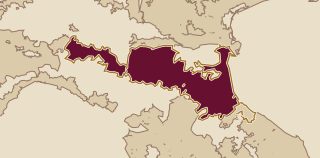
Predappio sits between the Apennines and the Adriatic Sea, at the boundary of the Casentinesi Forests and the Po Valley plain. The Rabbi valley runs through this landscape, bringing a biodiversity of flowers, insects, wildlife, and woodland that Condello treats as part of the farming context. The hills here are not dramatic in the way of Montalcino or Barolo, but they carry their own physical logic: elevation enough to cool the nights, slopes that drain well, and morning sun that falls hard on the east-facing plots.
Predappio's relationship with wine is old enough to have been written down. Viticultural regulations appear in the town's statutes of 1383, with further additions in 1400. Condello places his work inside that lineage without claiming invented heritage.
In the cellar
Vineyards and cellar
Sangiovese Piccolo carries smaller, more loosely spaced bunches than broader Sangiovese selections. The skins are thick, which delivers deeper colour and more concentrated fruit character into the wine. Manual harvesting and hand sorting are standard across the estate.
For Al Caleri, the fruit goes into stainless steel and ferments with indigenous yeasts, with a partial carbonic maceration element that preserves freshness and lifts the fruit. The approach is designed to retain what the fresher parcels naturally offer. For Raggio Brusa, the east-facing vineyard's thicker-skinned fruit goes through a longer ageing programme.
Wines to know
The range in view
Condé makes two wines, both from Sangiovese Piccolo, both carrying the long-ageing philosophy, each drawing from a different vineyard expression.
Al Caleri comes from the estate's cooler, fresher parcels. It is 100% Sangiovese, manually harvested, fermented in stainless steel with indigenous yeasts and a partial carbonic maceration. The partial carbonic step keeps the fruit vivid and the palate accessible: ripe red cherries, a soft earthy undertow, fine acidity, and tannins that have been given enough time in bottle to settle without losing their grip. The finish dries gradually, with some pleasant bitterness in the tail. It is the lighter-shouldered bottle, but not a thin one.
A useful way in
A bottle to begin with
Start with Al Caleri. It comes from the cooler parcels, fermented in stainless steel with indigenous yeasts and a touch of partial carbonic maceration, and held in bottle until Condello considers the tannins ready. It is a Sangiovese Piccolo with ripe red fruit, a firm but settled palate, fine acidity, and a dry finish with some bitterness at the close. It is a clear and honest expression of this grape and this place, accessible on release without compromising the character found in Predappio Sangiovese, distinct from better-known Romagna styles.