
Why it matters
The producer
José Maria da Fonseca has been making wine in Azeitão, a village on the Setúbal Peninsula south of Lisbon, since 1834. The family has remained in control across seven generations, and the portfolio today runs to more than forty wines, from everyday Castelão reds to the fortified Moscatel de Setúbal the peninsula has always been known for. Two things tie the range together: deep roots in one place, and the Periquita label, whose first bottle sold in 1850 and which still accounts for more than 1.5 million bottles a year.
The estate manages nearly 650 hectares of vineyards and operates out of a modern production facility built at the turn of this century. The scale is large, but the address has not changed: Azeitão, where the founder arrived after completing his studies in mathematics at the University of Coimbra.
Place and vineyards
Where the wines begin
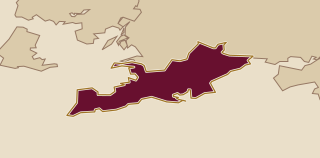
Azeitão sits on the Setúbal Peninsula between the Serra da Arrábida hills and the Sado estuary, south of Lisbon. The hills moderate the Atlantic influence enough to give the peninsula long, warm growing seasons while the estuary keeps temperatures from climbing too far. Those conditions do different things for different grapes: Castelão ripens into soft, ripe red fruit without the edge it can show in cooler zones, and Moscatel de Setúbal reaches the sugar levels that make fortification worthwhile, while the humidity along the lower slopes allows the Muscat varieties to develop aromatic intensity. Azeitão itself is the estate's permanent address, the place the founder chose in the 1830s and where the company has remained.
In the cellar
Vineyards and cellar
The estate farms nearly 650 hectares of vineyards. Castelão is the main red variety, suited to the Setúbal Peninsula's warm, relatively dry conditions. Old oak barrels are the ageing vessel for Periquita, a deliberate choice that keeps the wine from picking up heavy new-oak character while allowing it to soften over time.
The Fernando Soares Franco Winery handles production across the range. Its 9,000 square metre facility runs 513 tanks with a combined capacity of 6.5 million litres, giving the estate the flexibility to ferment and hold wines from a large and varied portfolio. The company has made environmental practice a measurable part of its operation: it was the first wine company in Portugal to receive the ISO 14001 environmental certification, and later the first winery in Portugal to obtain the FAIR'N GREEN sustainability certification.
Wines to know
The range in view
The range spans more than forty labels, but three bottles carry the most weight. Periquita Original is the everyday Castelão red, aged in large old oak barrels to a soft, approachable style and produced at more than 1.5 million bottles a year. Periquita Reserva steps up in concentration and depth, drawing on a selection of the estate's Castelão fruit for a more structured result. Alambre Moscatel de Setúbal is a fortified wine: grape spirit is added during fermentation to stop it while sugar remains, locking in the sweetness and the Muscat aromatic character, then the wine ages to develop its amber depth. The Setúbal appellation on the label is a specific designation for this style of fortified Moscatel, with rules distinct from the broader Setúbal Peninsula wines.
A useful way in
A bottle to begin with
Periquita Original is a Castelão red from the Setúbal Peninsula, aged in large old oak barrels and bottled for everyday drinking, and it is the bottle with the longest story behind it. The wine is soft and direct, with ripe red fruit, gentle oak and a finish that does not demand attention but rewards it. What it demonstrates is not complexity but consistency: a labeled, bottled Portuguese red in a recognisable style, produced at a scale that few estates anywhere in Portugal have matched. Periquita Reserva is the natural follow-up for those interested in what the same grape achieves with more selective sourcing, but Original is the bottle with the longer story.